
Everything You Need to Know About Dental Metal Cap Prices

What Does a Dental Metal Cap Cost? Here's What You Need to Know
dental metal cap price is one of the most common questions patients ask before committing to a crown procedure. Here's a quick answer:
| Location | Typical Price Range |
|---|---|
| United States (national average) | $800 - $2,500 per tooth |
| With dental membership plan | $520 - $830 per tooth |
| With 50% insurance coverage | $400 - $1,250 out of pocket |
| Mexico (dental tourism) | $100 - $200 per tooth |
Prices vary based on material type, your location, dentist experience, and whether additional treatments like a root canal are needed.
Your teeth take a beating over a lifetime. Decay, cracks, accidents, and aging can all leave a tooth too damaged for a simple filling. That's where a metal dental cap — also called a metal crown — comes in.
Metal crowns are one of the oldest and most durable tooth restoration options available. Dentists have used them for decades, especially on back molars where chewing pressure is highest.
But cost is a real concern for most families. Dental work isn't cheap, and crown procedures can feel overwhelming when you don't know what to expect on the bill.
This guide breaks down everything clearly — what drives the price, what your insurance likely covers, and what you can realistically expect to pay at a practice like Logan Dental Care here in Bellefontaine, Ohio.
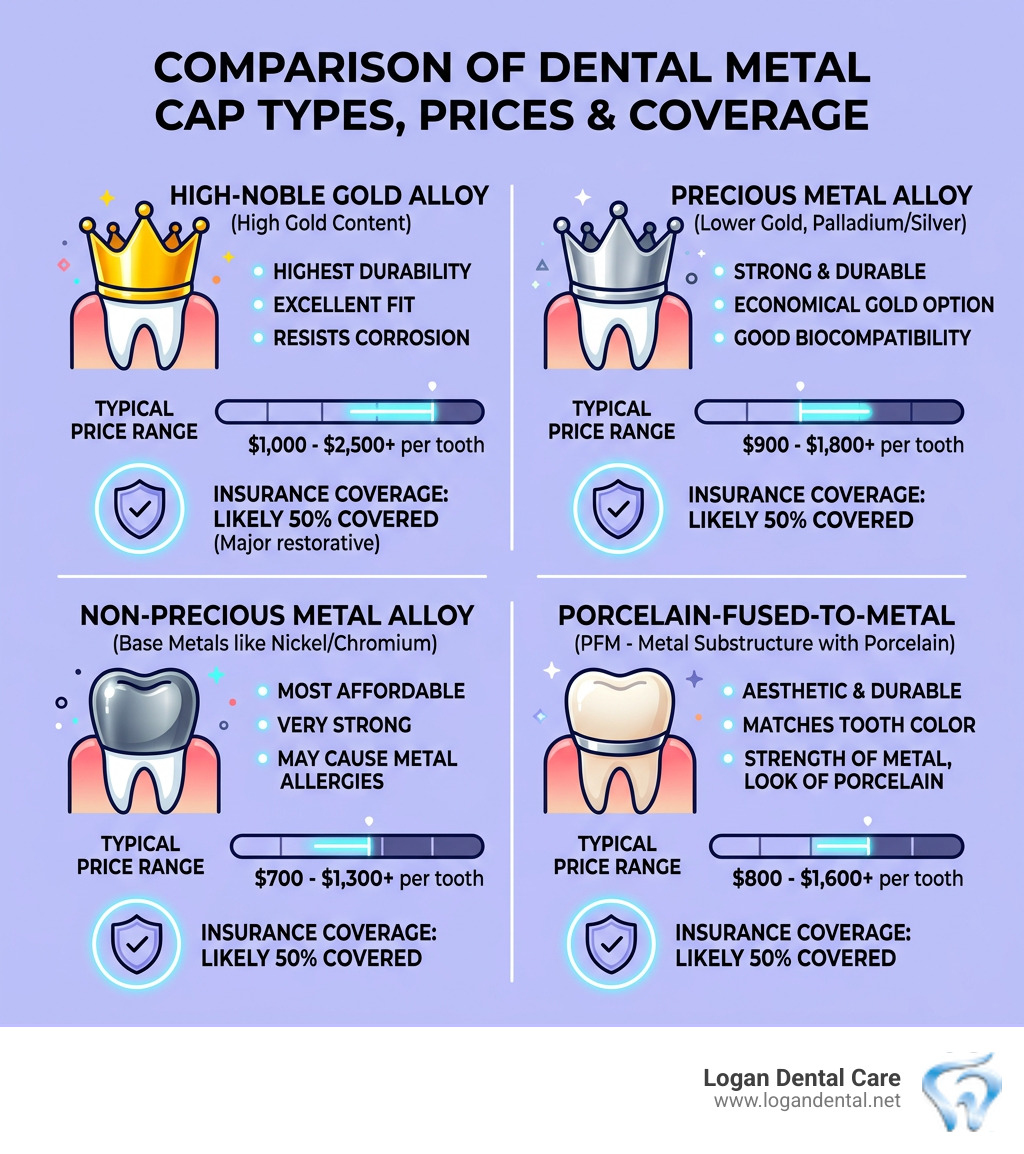
Metal Dental Cap Types and Material Costs
When we talk about a dental cap, we are talking about a custom-made restoration that fits over your existing tooth like a protective helmet. In metal caps, not all metals are created equal. The specific "recipe" of metals used in your crown is the primary driver of the price you will see on your treatment plan.

Average dental metal cap price for Gold and Base Alloys
In dentistry, we generally categorize metal crowns into three groups based on their "nobility"—which is just a fancy way of saying how much precious metal (like gold or platinum) is in the mix.
- High Noble Alloys: These contain at least 60% noble metal (gold, platinum, or palladium), of which at least 40% must be gold. Because gold is a commodity with a fluctuating market value, the high noble metal crown price is often the highest among all-metal options. Gold is incredibly biocompatible, meaning your gums love it, and it wears down at a rate very similar to natural tooth enamel.
- Noble Alloys: These contain at least 25% noble metal. They offer a middle ground in terms of cost and performance.
- Base Metal Alloys: These contain less than 25% noble metal and are often made of nickel, chromium, or cobalt. These are typically the most budget-friendly metal options. They are extremely strong and resistant to corrosion, though some patients may have sensitivities to metals like nickel.
| Metal Category | Typical Composition | Cost Level |
|---|---|---|
| High Noble | 40%+ Gold, Platinum, Palladium | Highest |
| Noble | 25%+ Precious Metals | Mid-Range |
| Base Metal | Nickel, Chromium, Cobalt | Lowest |
For those who want the strength of metal but the look of a natural tooth, there is the porcelain fused to high noble metal crown cost to consider. This "hybrid" crown uses a metal sub-structure for strength with a porcelain "skin" baked over the top to match your surrounding teeth.
Benefits and Drawbacks of Metal vs. Porcelain
Choosing between a metal cap and a ceramic teeth cap usually comes down to a trade-off between how it looks and how long it lasts.
Metal caps are the "workhorses" of the mouth. Because metal is incredibly strong even when thin, we don't have to remove as much of your natural tooth structure to make it fit. They almost never chip or break, making them ideal for back molars where you do all your heavy-duty chewing.
On the flip side, most people don't want a "metal mouth" in their smile line. For front teeth, patients almost always choose porcelain or zirconia for their lifelike transparency. If you're weighing these options, our dental crown options: ultimate guide provides a deeper dive into which material fits which tooth best.
Factors That Influence Your dental metal cap price
If you've ever called three different dental offices and received three different quotes, you know that pricing isn't always straightforward. Several "behind-the-scenes" factors influence the final number.
First, there are laboratory fees. Most dentists, including us at Logan Dental Care, work with highly skilled dental technicians who hand-craft your crown in a lab. The quality of the lab and the materials they source (like certified dental gold versus jewelry-grade gold) impacts the dental crown cost.
Geographic location also plays a role. Running a dental practice in a major metropolitan area like New York or Chicago comes with much higher overhead than a family practice in Bellefontaine, Ohio. We take pride in offering high-quality care that reflects our local community's values and economic reality.
Finally, the complexity of the case matters. A crown for a simple cracked tooth is different from a crown needed to protect a tooth after a complex infection. If you're curious about the intersection of infection and restoration, check out your guide to root canals and crowns.
How Insurance Impacts Your dental metal cap price
Most dental insurance plans classify a crown as a "Major Restorative" procedure. Unlike a cleaning (which is usually covered at 100%) or a filling (usually 80%), crowns are typically covered at 50%.
However, there are a few "gotchas" to watch out for:
- Deductibles: You'll likely have to pay your annual deductible (often $50–$100) before the 50% coverage kicks in.
- Annual Maximums: Most plans cap their total payout for the year at $1,000 to $1,500. If your crown and other treatments exceed this, you're responsible for the remainder.
- Waiting Periods: Some new plans make you wait 6 to 12 months before they will pay for a crown.
For a full breakdown of how to navigate these numbers, our dental crowns cost complete guide is an excellent resource for planning your budget.
Additional Treatments and Total Costs
The dental metal cap price is rarely the only line item on the bill. To ensure the crown lasts for 20 years, the "foundation" of the tooth must be solid.
Common additions include:
- Core Buildup: If much of the natural tooth is missing due to decay, we use a special filling material to "build up" the tooth so the crown has something to grab onto.
- Diagnostic X-rays: We need clear images to see the roots and bone health before we start.
- Gingivectomy: Occasionally, we need to gently reshape the gum line to make sure the crown fits perfectly.
We always recommend a thorough dental crown consultation complete guide to ensure there are no surprises when the final bill arrives.
Procedure, Durability, and Long-Term Maintenance
Getting a metal crown is usually a two-visit process. During the first visit, we numb the area, remove any decay, and shape the tooth. We then take an impression (either with a putty-like material or a digital scanner) and send it to the lab.
While the lab spends a week or two crafting your permanent metal cap, we place a temporary crown to protect your tooth. In some cases, technology allows for a dental crown same day, though this is more common with ceramic materials than with cast gold or metal alloys.
For a step-by-step look at the entire journey, see our crowns bridges complete guide.
Maximizing the Lifespan of Metal Caps
Metal caps are famous for their longevity. While a porcelain crown might last 10 to 15 years, a well-maintained gold or base-metal crown can easily last 20 years or more. Some patients have kept their gold crowns for 40 years!
To get that kind of ROI on your dental metal cap price, you need to follow a few simple rules:
- Brush and Floss: You can't get a cavity on the metal, but you can get one underneath it where the metal meets the tooth.
- Night Guards: If you grind your teeth at night (bruxism), the constant pressure can eventually break the cement seal. A custom night guard is a cheap way to protect an expensive investment.
- Routine Check-ups: We need to check the "margins" (the edges) of the crown every six months to make sure the seal is still tight.
Frequently Asked Questions about Dental Metal Cap Prices
Are metal dental crowns safe and durable?
Yes, absolutely. Metal alloys used in dentistry are FDA-approved and have been studied for decades. In terms of durability, they are the gold standard (pun intended). They handle chewing forces better than any other material and are the least likely to fracture. The only real "risk" is a rare metal allergy, which we discuss with you during your consultation.
Conclusion
At Logan Dental Care, we understand that a dental metal cap price represents a significant investment in your health. As a family-focused practice in Bellefontaine, Ohio, our mission is to provide transparent, high-quality care that feels like you're being treated by family.
Whether you're from Zanesfield, West Liberty, or right here in Bellefontaine, we combine modern technology with small-town warmth to make sure your smile stays strong for decades to come. If you think you might need a crown, don't wait until the tooth breaks further—early intervention is always the most cost-effective path.