
How to Get Straight Teeth Without the Metal Mouth

Straight Teeth Without the Metal: What You Need to Know About Invisible Teeth Straighteners
Invisible teeth straighteners are orthodontic devices that move your teeth into alignment without metal brackets or wires — and in April 2026, you have more options than ever.
Here's a quick overview of what's available:
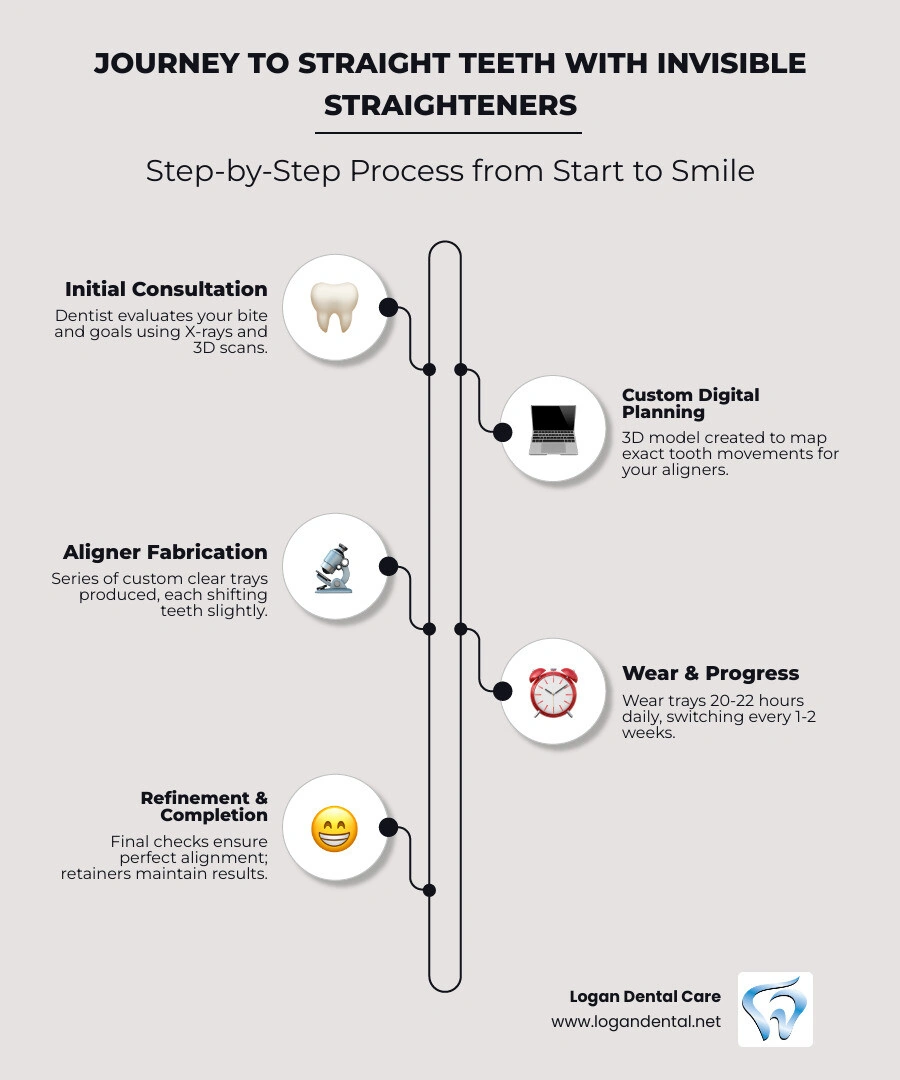
Clear aligners (in-office): Custom plastic trays you wear 20-22 hours a day and switch every 1-2 weeks. Often a good fit for mild to moderate crowding, gaps, and some bite issues.
At-home clear aligners: A similar tray-based approach, but impressions are taken at home with remote oversight. Usually limited to minor spacing or small relapse after past treatment.
Lingual braces: Fixed brackets placed behind the teeth, so they stay hidden while applying steady pressure. Often used for moderate to complex cases.
Most people picture metal braces when they think about straightening their teeth. But today, there are discreet options that most people around you will never even notice.
The tradeoff isn't just about looks. Each type of invisible straightener works differently, costs differently, and fits different lifestyles and dental needs.
Some options — like in-office clear aligners from Invisalign or Motto — involve regular check-ins with a dentist and can handle more complex bite problems. Others, like at-home aligner brands, offer lower costs but limited professional oversight, which matters more than many people realize.
The right choice depends on your teeth, your budget, and how much professional guidance you want.
This guide breaks it all down so you can walk into a conversation with your dentist already knowing what questions to ask.
Understanding the Types of Invisible Orthodontics
When we talk about invisible teeth straighteners, we are generally looking at two main categories: clear aligners and lingual braces. Both aim for the same goal—a straighter smile—but the journey to get there looks very different.
What Are Clear Aligners? Think of them as a series of thin, transparent, medical-grade plastic trays. These Invisible Aligners are custom-fit to your teeth using high-tech 3D scans. Each tray in the series is slightly different, applying gentle, constant pressure to shift your teeth a fraction of a millimeter at a time. Because they are clear, they are virtually undetectable to the casual observer.
On the other hand, lingual braces take a "hidden in plain sight" approach. These are traditional brackets and wires, but they are bonded to the back (lingual side) of your teeth. Brands like Incognito or InSmile use digital design and robotics to create custom brackets that follow the unique contours of your teeth. Some newer systems, such as InTeeth, even use "Smartwire" technology or lingual aligners that provide 6D control over tooth movement without the bulk of traditional braces.
Choosing the Right Invisible Teeth Straighteners for Your Lifestyle
We often find that the "best" option isn't just about the technology—it’s about how you live your life here in Bellefontaine.
Clear aligners offer incredible convenience because they are removable. You can take them out to eat, drink anything other than water, and brush your teeth. This means you don't have to give up popcorn at the Logan County Fair or struggle to floss around wires. However, that freedom comes with a catch: you must wear them for at least 22 hours a day. If you’re the type of person who might leave your trays on the bedside table or lose them in a napkin at lunch, a fixed option like lingual braces might be a better fit.
When you work with an Invisible Braces Orthodontist, we look at these lifestyle factors. Lingual braces are "always on," which means they are working 24/7 without you having to remember to put them back in. For busy professionals or students who don't want to worry about compliance, this "set it and forget it" nature is a huge plus.
How Invisible Teeth Straighteners Correct Complex Bites
A common myth is that invisible teeth straighteners are only for "easy" cases. While that may have been true ten years ago, modern technology has changed the game.
Today, we use these tools to treat a wide range of orthodontics issues, including:
- Overbite: When upper teeth overlap lower teeth too much.
- Underbite: When lower teeth protrude past upper teeth.
- Crossbite: When upper and lower jaws don't line up.
- Crowding and Gaps: When there isn't enough space or too much space between teeth.
Advanced systems like InTeeth use patented connectors and 6D control to move teeth in any direction, including inward movement that was once very difficult for aligners to achieve. For in-office aligners, we often use "attachments"—tiny, tooth-colored bumps bonded to your teeth—that act like handles, giving the aligner more grip to rotate or lift teeth into place.
Cost, Duration, and Insurance Coverage
We know that budget is a major factor for families in our community. While we won't quote exact prices here (as every mouth is different!), we can look at the general landscape as of April 2026.
Clear aligners (in-office): Usually cost $3,000-$7,000, with treatment often taking 6-18 months. They include regular in-person supervision and can treat many mild, moderate, and some more complex cases.
Lingual braces: Usually cost $5,000-$10,000, with treatment often taking 12-24 months. They are monitored in person and can handle moderate to severe orthodontic needs.
At-home aligners: Usually cost $1,000-$2,500, with treatment often taking 4-10 months. Supervision is typically remote, so they are generally best suited for very mild tooth movement only.
How Long Does Invisalign Take? For many of our patients with mild crowding, we see results in as little as 6 months. However, more complex bite corrections can take 18 months or more. The goal is to align your teeth safely, which sometimes requires a bit more time to ensure the roots stay healthy.
The good news is that 92% of US patients with dental insurance qualify for some level of orthodontic coverage, often up to $3,000. Most plans treat invisible teeth straighteners the same way they treat traditional braces. Additionally, you can use your HSA (Health Savings Account) or FSA (Flexible Spending Account) to pay for treatment with pre-tax dollars. Many providers also offer monthly financing plans to make the cost manageable for the family budget.
Factors Influencing Your Treatment Timeline
No two smiles move at the same speed. Several factors will determine how long you’ll be wearing your What Is Invisalign or lingual trays:
- Case Complexity: Closing a tiny gap is much faster than correcting a deep overbite.
- Compliance: If you don't wear your aligners for the required 22 hours a day, your teeth won't move as planned, and your treatment time will stretch out.
- Biological Response: Some people’s bone and gum tissue simply reshape faster than others.
- Refinements: At the end of your initial series of trays, we often order a few "refinement" trays to get those last few teeth into perfect position.
The Vital Role of Professional Supervision
It is tempting to look at at-home aligner kits and think, "I can do this myself." However, the American Dental Association (ADA) and the American Association of Orthodontists (AAO) have issued warnings regarding direct-to-consumer orthodontics.
Straightening teeth is a medical procedure, not just a cosmetic one. When you choose Invisalign R Clear Aligners A Modern Solution For Straightening Teeth, you aren't just buying plastic; you are paying for professional oversight.

At Logan Dental Care, we start with a comprehensive exam, including X-rays. We need to see what’s happening beneath the surface. If you have underlying gum disease or a tooth with a short root, moving those teeth without supervision could lead to permanent tooth loss.
Professional supervision also means:
- Digital Impressions: Using 3D scanners to create a perfect map of your mouth (no more goopy putty!).
- Attachment Placement: Strategically placing those "handles" we mentioned to ensure predictable movement.
- Bite Alignment: Ensuring your teeth don't just look straight but actually fit together correctly. An improper bite can lead to jaw pain (TMJ) and worn-down teeth later in life.
- Relapse Prevention: Monitoring your progress to ensure your teeth aren't moving too fast, which can cause them to bounce back later.
Using Maximizing Your Smile With Suresmile R Aligners Benefits And Process as an example, the process is built around precision. Having a doctor physically check your progress every 4-8 weeks ensures that if a tooth isn't "tracking" (moving as the software predicted), we can catch it early and adjust your plan.
Frequently Asked Questions about Invisible Teeth Straighteners

Choosing between Braces Vs Invisalign R Which Orthodontic Treatment Is Right For You often comes down to the daily details. Here are the questions we hear most often in our Bellefontaine office.
Will they affect my speech?
Any time you put something new in your mouth—whether it’s a clear aligner or lingual braces—your tongue has to adjust. With clear aligners, you might have a slight lisp for the first day or two, but it usually disappears quickly. Lingual braces can be a bit trickier since they sit right where your tongue touches to make certain sounds. Most patients find their speech returns to normal within one to two weeks. Pro tip: Practice reading the "Rainbow Passage" out loud to speed up the adjustment!
Are they painful to wear?
We prefer the word "pressure" over "pain." When you switch to a new set of invisible teeth straighteners, you’ll feel a snug sensation for the first 24-48 hours. This is actually a good sign—it means the aligners are doing their job! Compared to traditional metal braces, which can poke or scrape your cheeks, clear aligners are much more comfortable because they are trimmed to your unique gum line.
How do I maintain my results after treatment?
This is the most important part: Retainers are for life. Once your teeth are in their perfect positions, the bone around them needs time to harden and "lock" them in. If you don't wear a retainer, your teeth will naturally want to drift back to where they started. We typically provide custom-fit retainers (like Vivera) that you wear only at night. Think of it as "pajamas for your teeth."
Conclusion
At Logan Dental Care, we believe that every resident of Bellefontaine, Ohio, deserves a smile they are proud to show off. Whether you are a busy professional in Zanesfield, a student in West Liberty, or a retiree in Russels Point, modern invisible teeth straighteners offer a path to a better smile without the "metal mouth" of the past.
We take pride in our community-focused approach. When you come to see us for Invisalign Bellefontaine, you aren't just another chart number; you’re a neighbor. Our goal is to provide high-quality, transparent care that fits your life and protects your long-term oral health.
If you’re ready to see what’s possible for your smile, we’d love to help. Schedule your orthodontic consultation with us today, and let's find the discreet solution that works for you.