
Everything You Need to Know About Clear Plastic Aligners

Clear Aligners: The Modern Answer to a Straighter Smile
What are clear aligners? They are custom-made, nearly invisible plastic trays that fit snugly over your teeth and use gentle pressure to gradually shift them into proper alignment — no metal brackets, no wires, no drama.
Here's a quick breakdown:
- What they are: Transparent, removable plastic shells (also called invisible braces or clear aligner trays)
- How they work: Each tray moves your teeth slightly; you swap to a new set every one to two weeks
- Who they're for: Adults and teens with mild to moderate crowding, spacing, or bite issues
- Wear time: 20–22 hours per day for best results
- Average treatment time: Around 13.5 months (as little as 6 months for simpler cases)
- Key benefit: You can remove them to eat, brush, and floss — unlike traditional braces
Crooked or crowded teeth aren't just a cosmetic issue. They make cleaning harder, which raises your risk of tooth decay and gum disease. For years, metal braces were the main fix — but a lot of adults simply didn't want to wear visible brackets for a year or two.
That's where clear aligners changed everything.
Since Invisalign introduced the concept in the late 1990s, the technology has treated over 12 million patients worldwide. Today, clear aligners are the go-to choice for busy adults who want results without the look — or the hassle — of traditional braces.
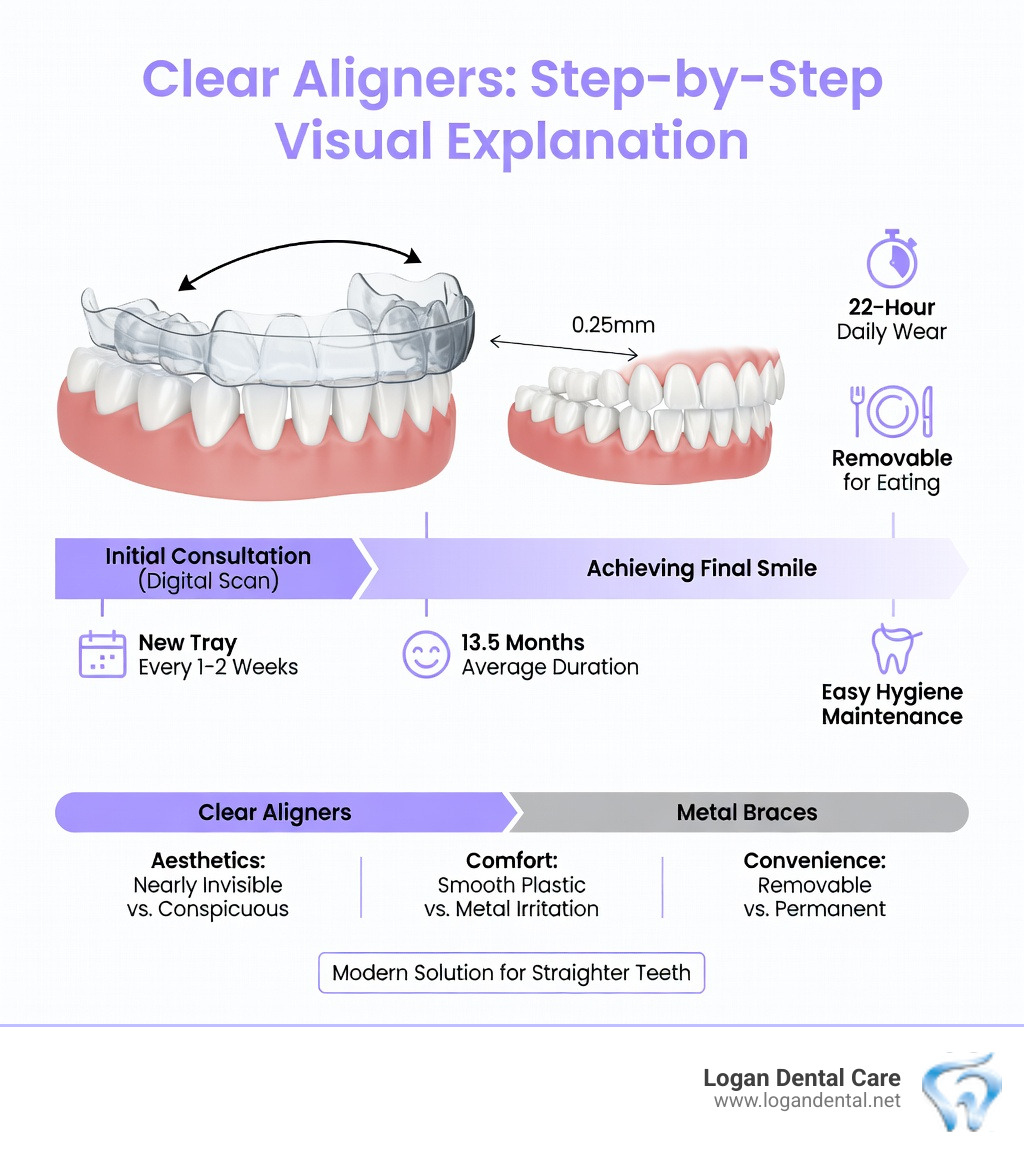
What Are Clear Aligners and How Do They Work?
When patients in Bellefontaine ask us, "what are clear aligners?" we like to describe them as a high-tech GPS for your teeth. Instead of using brackets and wires to pull teeth into place, these systems use a series of custom-molded thermoplastic trays to push them.
Each tray is engineered to be slightly different from the one before it. When you snap the aligner over your teeth, it fits tightly because it represents where your teeth should be at the end of that specific stage. This tightness creates gentle, constant pressure. Over the course of one to two weeks, your teeth respond to this pressure by moving a fraction of a millimeter.
According to scientific research on clear aligner efficacy, these devices are highly effective at controlling tooth movement when worn consistently. By the time you reach the end of your series of trays, those tiny increments add up to a complete smile transformation. You can learn more about how we integrate these tools into our orthodontic services to help our neighbors in Logan County achieve the smiles they've always wanted.
The Technology Behind What Are Clear Aligners
The magic of modern aligners isn't just in the plastic; it’s in the digital planning. The process begins with a 3D digital scan of your mouth—no more messy, goopy putty impressions! This scan creates a precise digital map of your current smile.
Using CAD/CAM (Computer-Aided Design and Computer-Aided Manufacturing) technology, we can visualize the entire movement of your teeth before you even wear your first tray.
- Precision Movement: Teeth are moved in increments as small as 0.25mm per tray.
- Material Science: Advanced materials like SmartTrack are designed specifically for orthodontic use. These materials provide more predictable tooth movements and are more comfortable than older, stiffer plastics.
- Custom Trimming: To ensure the trays don't irritate your gums, they are often trimmed based on your specific gum line. This prevents the "digging" sensation that some lower-quality aligners might cause.
- 3D Printing: Once the digital plan is finalized, each set of trays in your series is 3D printed with surgical precision.
Comparing Clear Aligners to Traditional Braces
Choosing between aligners and traditional braces is a big decision. While both are effective forms of orthodontic treatment, they offer very different daily experiences.
FeatureClear AlignersTraditional BracesAppearanceVirtually invisible; clear plasticVisible metal or ceramic bracketsRemovabilityRemovable for eating and cleaningFixed; stays on 24/7DietNo restrictions (remove to eat)Avoid sticky, hard, or chewy foodsHygieneEasy; brush and floss normallyRequires special tools (threaders)ComfortSmooth plastic; less soft tissue irritationBrackets and wires can poke or scratchMaintenanceSwap trays at home every 1-2 weeksRequires monthly office adjustments
As noted in this guide on Traditional Braces vs Clear Aligners, the primary "pro" for aligners is the lifestyle flexibility. You don't have to worry about a bracket breaking during a big presentation or a wire poking you during a weekend trip. However, because they are removable, the success of the treatment is entirely in your hands!
Ideal Candidates for What Are Clear Aligners
While technology has advanced significantly, clear aligners aren't a "one-size-fits-all" solution. They are fantastic for many issues, but some complex cases still require the heavy-duty mechanics of traditional braces.
You might be an ideal candidate if you have:
- Mild to Moderate Crowding: When there isn't quite enough room in your jaw for all your teeth to fit normally.
- Gaps and Spacing: Small to medium spaces between teeth.
- Simple Bite Issues: This includes mild overbites, underbites, or crossbites.
- Relapse Correction: Many of our adult patients had braces as kids but forgot to wear their retainers. Aligners are perfect for shifting those teeth back into place.
Clear aligners are especially popular for orthodontic treatment for adults because they allow you to maintain a professional appearance. Teens also love them because they don't have to worry about "metal mouth" in school photos or during sports. However, if a case involves severe tooth rotation or requires moving teeth vertically (extrusion), we may recommend a different approach.
The Treatment Journey and Cost Considerations
Starting your journey toward a straighter smile is exciting, but it’s helpful to know what the road ahead looks like. On average, the treatment duration is about 13.5 months, though simple cases can be finished in as little as six.
The Golden Rule of Aligners: The 22-Hour Rule.For the trays to work, they have to be in your mouth. You should only take them out to eat, drink anything other than plain water, and perform your oral hygiene routine. If you leave them on the nightstand, your teeth aren't moving!
What about the investment?We understand that orthodontic treatment cost is a major factor for families in Bellefontaine. Generally, clear aligner treatment is comparable in price to traditional braces, usually ranging between $3,000 and $7,000 depending on the complexity.
Payment and Financing Options:
- Insurance: Many dental insurance plans offer an orthodontic benefit that can cover up to $2,500 or $3,000 of the cost.
- HSA/FSA: You can use your Health Savings Account or Flexible Spending Account pre-tax dollars to pay for treatment.
- Monthly Financing: We offer flexible payment plans to help fit the cost into your monthly budget. We believe a beautiful smile should be accessible to everyone in our community.
Why Professional Supervision Matters
In recent years, "mail-order" or direct-to-consumer aligner companies have popped up. While the lower price tag is tempting, there are significant risks to straightening your teeth without a doctor's supervision.
Teeth are not just "pegs" sitting in your gums; they are living organs attached to your jawbone by ligaments and blood vessels. If you move them too fast or in the wrong direction, you can cause permanent damage, including root resorption (where the roots of your teeth literally shrink) or bone loss.
A professional consultation is vital because we take full X-rays and 3D scans to ensure your roots and bone are healthy enough for movement. We also monitor your progress every 6 to 8 weeks. If a tooth isn't "tracking" (moving as planned), we can catch it early and adjust your plan. Research on clear aligner movement emphasizes that clinical oversight is the best way to ensure a safe and predictable outcome.
Maintaining Your Results After Treatment
You’ve finished your last tray, and your smile looks incredible—congratulations! But the journey doesn't end the day you stop wearing aligners. Your teeth have a "memory" and will naturally want to drift back to their old, crooked positions. This is known as relapse.
To prevent this, you must wear orthodontic retainers. Initially, you may need to wear them during the day, but eventually, most patients transition to nightly wear. Retainers hold your teeth in their new positions while the bone around the roots solidifies and "locks" them in place.
Think of your retainer as an insurance policy for your smile. At Logan Dental Care, we provide detailed guidance on invisible aligners and retention to make sure that the investment you made in your smile lasts a lifetime.
Conclusion: Starting Your Journey at Logan Dental Care
Understanding what are clear aligners is the first step toward the smile you've always dreamed of. Whether you're a busy professional in Bellefontaine or a student in Logan County, this technology offers a discreet, comfortable, and effective way to improve your oral health and boost your confidence.
At Logan Dental Care, we combine the latest orthodontic technology with a warm, family-friendly atmosphere. We don't just see you as a patient; we see you as a neighbor. Our team is here to guide you through every step of the process, from that first digital scan to the day you see your new smile in the mirror for the first time.
Ready to see if clear aligners are right for you? We’d love to help. Contact us today to schedule your consultation and take the first step toward a healthier, straighter smile. For more information on all things dental health, explore our guide to orthodontics. We can't wait to meet you!