
A Practical Guide to Dental Implants vs Bridges
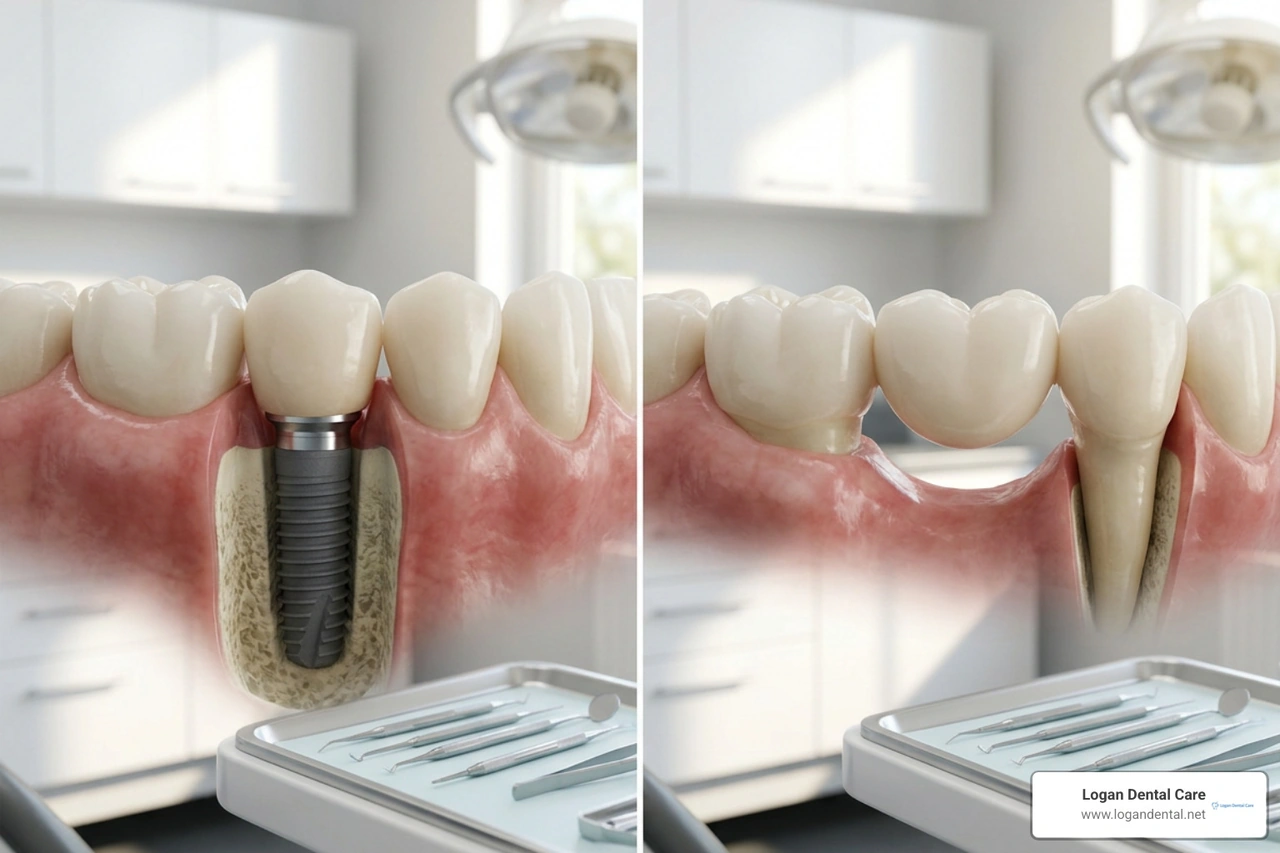
Dental Implants vs Bridges: How to Choose
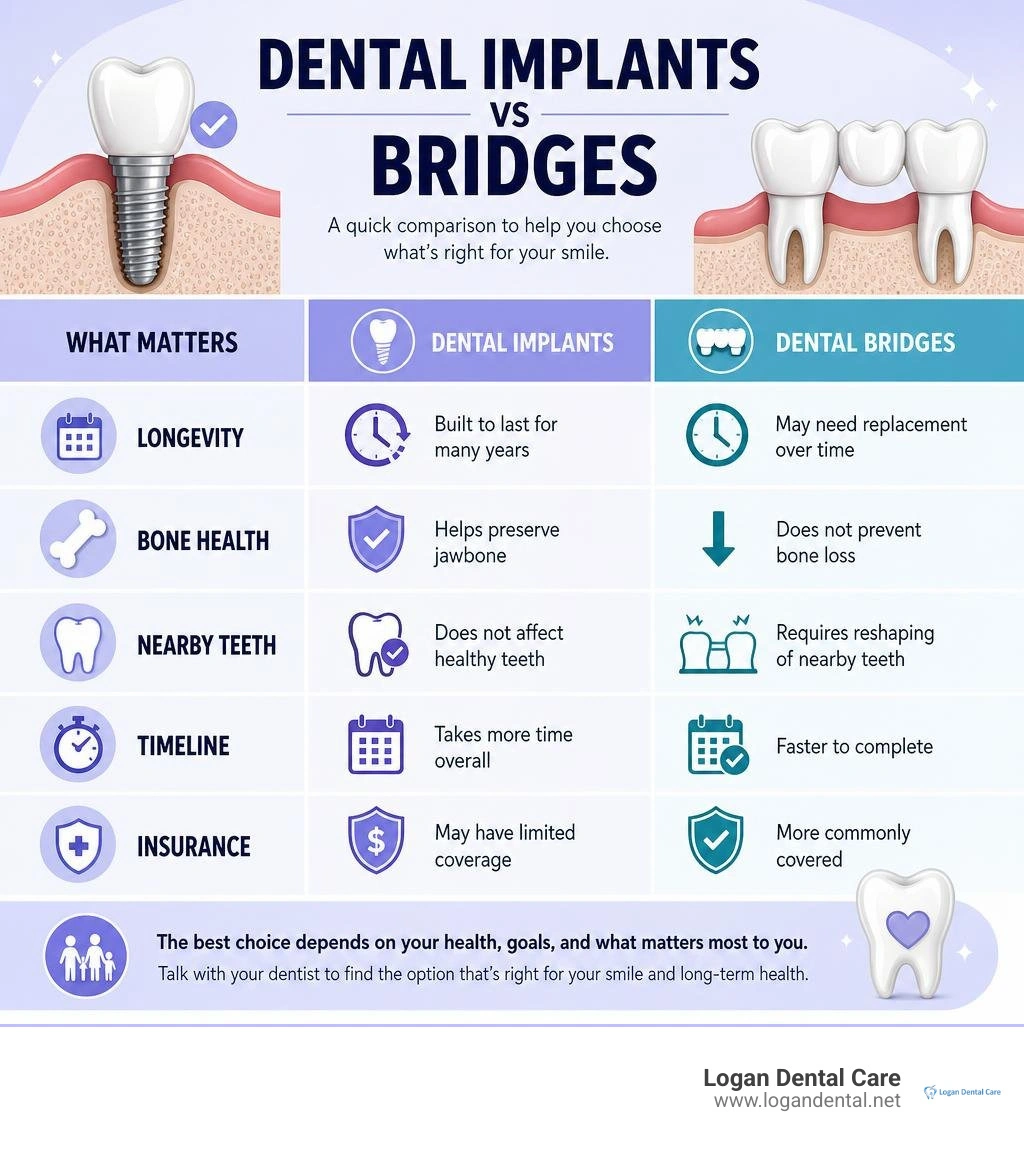
Dental implants usually make the best long-term choice when you have healthy gums and enough jawbone. They replace both the tooth root and the visible tooth, preserve nearby teeth, and help limit bone loss. A dental bridge can be the better choice when you want a faster, non-surgical option or the teeth beside the gap already need crowns.
Here is the quick comparison:
| Priority | Often the better fit |
|---|---|
| Preserve healthy neighboring teeth and jawbone | Dental implant |
| Avoid surgery and finish treatment sooner | Dental bridge |
| Lower initial expense and more common insurance coverage | Dental bridge |
| Long-term durability and a natural feel when chewing | Dental implant |
Missing teeth are common, but they can affect more than your smile. A gap can make chewing and speaking harder, allow nearby teeth to shift, and lead to bone loss in the jaw over time. The right choice depends on your health, the condition of nearby teeth, your timeline, and what feels manageable for your family.
At Logan Dental Care, our family-focused practice at 1021 N. Main Street in Bellefontaine, Ohio, can help you weigh these options without pressure; we are accredited members of the American Dental Association and Ohio Dental Association with an A+ BBB rating, and we do not offer payment plan options or sedation dentistry.
Dental implants vs bridges vocabulary:
Understanding Dental Implants vs Bridges: Core Differences and Procedures
Across the United States, roughly 120 million people are missing at least one tooth. By age 44, nearly 69% of adults have lost an adult tooth. While tooth loss is incredibly common, leaving that gap open can cause surrounding teeth to drift out of alignment and disrupt your bite.
When replacing a tooth, your two primary fixed options are dental implants and dental bridges. While both restore the appearance and chewing function of your smile, they function entirely differently beneath the surface. As outlined in the Cleveland Clinic guide on dental bridge vs implant, the essential difference comes down to how each restoration is anchored within your mouth.
A dental implant acts as an individual, standalone replacement for a missing tooth from the root to the chewing surface. In contrast, a traditional bridge for teeth is a single restoration consisting of an artificial tooth (called a pontic) anchored securely to the neighboring natural teeth on either side of the empty space.
What Is a Dental Implant?
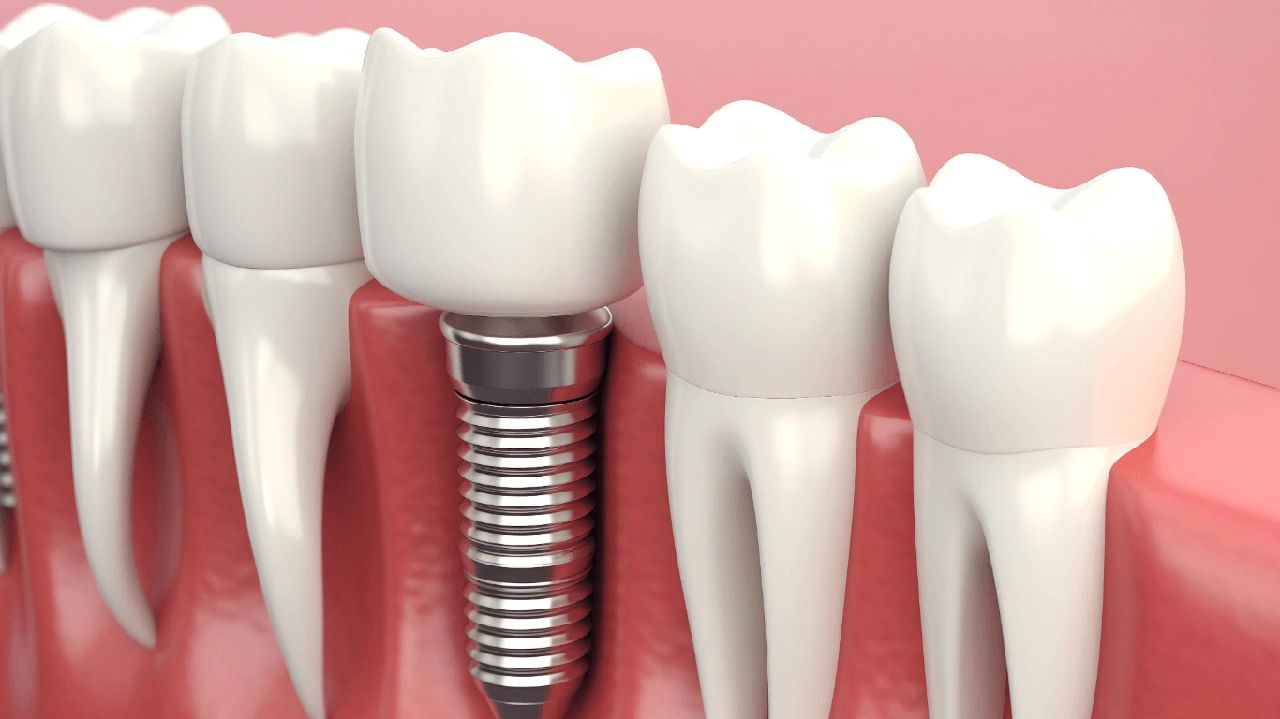
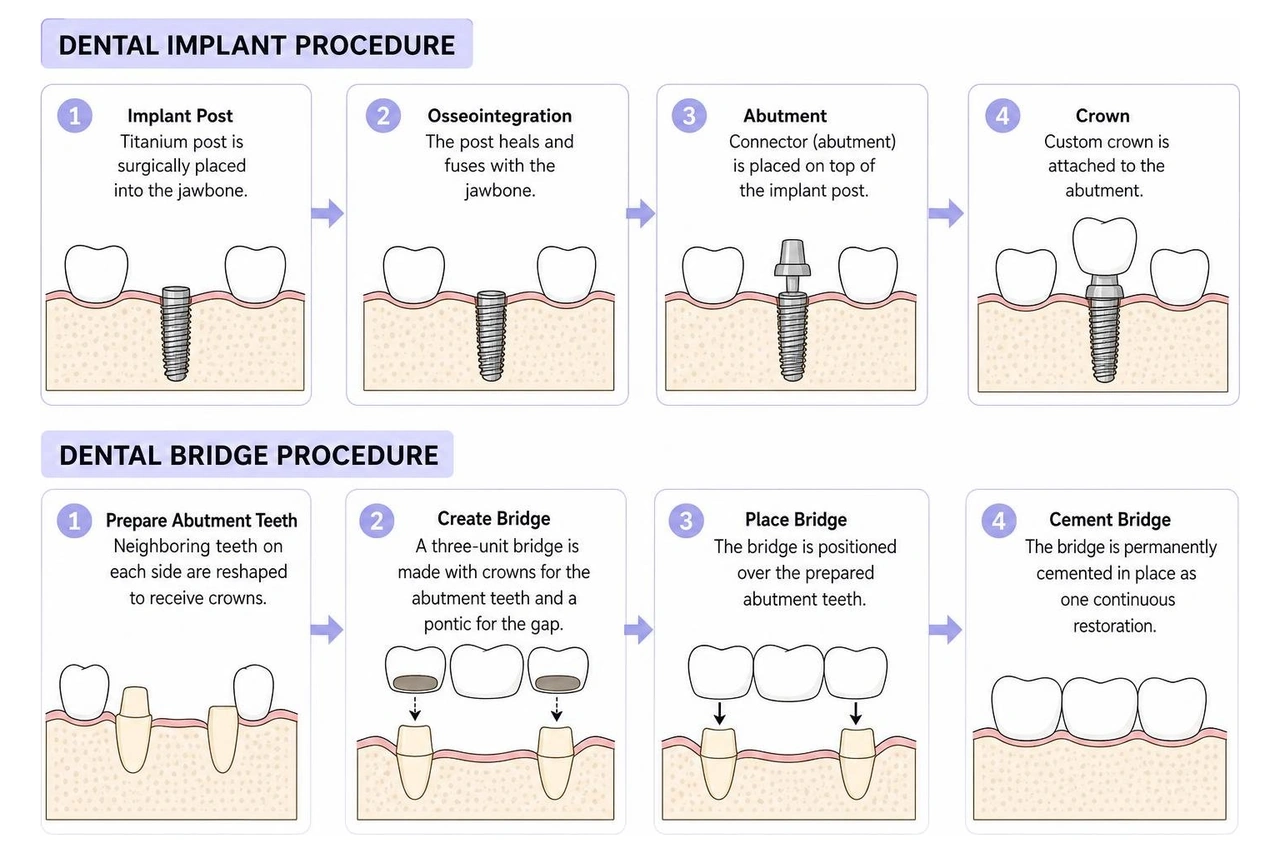
A dental implant is designed to replicate the complete anatomy of a natural tooth. It consists of three primary components:
- The Implant Post: A small screw, typically made of biocompatible medical-grade titanium, surgically placed directly into the jawbone to serve as an artificial root.
- The Abutment: A connector piece placed on top of the implant post once it has healed.
- The Crown: A custom-crafted porcelain or ceramic tooth that attaches to the abutment, perfectly matched in shape and shade to your surrounding teeth.
After the post is placed, the surrounding bone fuses securely to the titanium in a natural biological process known as osseointegration. If you are exploring your options, learning about the different types of dental implants and asking are tooth implants safe can help provide peace of mind before getting started.
What Is a Dental Bridge?
A traditional dental bridge spans the gap where your natural tooth once sat. To anchor this replacement tooth, the healthy natural teeth on either side (called abutment teeth) must be reshaped.
During the bridge preparation process:
- A portion of the protective enamel is gently removed from each neighboring tooth so they can receive fitted dental caps (anchor crowns).
- The central replacement tooth (the pontic) is bonded directly between these two anchor crowns.
- The entire three-unit piece is permanently cemented in place as one continuous restoration.
To explore the mechanics and maintenance of this restoration further, check out our bridgework teeth complete guide and review other teeth bridge options available for different areas of the mouth.
Longevity, Bone Preservation, and Oral Health Impact
Every tooth root actively stimulates the jawbone during daily chewing. When a tooth is lost, that natural stimulation stops. Within the first year of losing a tooth, the jawbone in that specific area can lose approximately 25% of its total width due to bone resorption (natural bone shrinkage).
Understanding how long do tooth implants last involves looking at how each restoration interacts with your bone and surrounding teeth over decades.
How Dental Implants vs Bridges Affect Neighboring Teeth and Jawbone
Because an implant sits directly inside the bone, it mimics a natural root and continues to stimulate the jaw every time you eat. This prevents bone resorption, helping you maintain your natural jawline and facial structure over time. Furthermore, an implant is completely self-supporting—meaning your neighboring teeth remain untouched and intact.
A dental bridge, by comparison, rests on top of the gum line. Because there is no root stimulating the bone beneath the artificial pontic tooth, the underlying jawbone will gradually lose density over the years. Additionally, traditional bridges require permanently altering the healthy enamel of two neighboring teeth, leaving those supporting teeth vulnerable to wear or decay under the crown margins. Understanding these long-term dynamics is a vital step when managing missing teeth.
Lifespan and Durability: Dental Implants vs Bridges over Time
When considering long-term durability, implants and bridges follow very different timelines:
- Dental Implants: Implants boast a 10-year clinical success rate of 94% to 98%. The titanium post placed in your bone is engineered to last a lifetime (often 25 to 40+ years) with good home care. The visible custom crown attached to it typically lasts 10 to 20 years before needing normal maintenance or replacement.
- Dental Bridges: Bridges typically last between 5 and 15 years before needing replacement. In fact, long-term systematic reviews of conventional bridges show a survival rate of approximately 74% at 15 years. Over time, recurring tooth decay around the edges of the anchor crowns or weakening of the supporting teeth often requires the entire bridge to be removed and remade.
Protecting your investment is essential. Whether you choose an implant or a bridge, pairing your restoration with proactive preventive care—such as custom nightguards to shield your teeth from nighttime clenching or grinding—ensures your smile stays protected for the long haul.
Comparing Costs, Timelines, and Recovery Experiences
Replacing a missing tooth involves balancing treatment timelines, recovery comfort, and overall value. For patients without dental insurance, our practice proudly offers the Smile Protection Savings Plan, designed to make routine general and preventive dentistry clear, transparent, and budget-friendly.
If you are researching restoration finances, exploring the cost of dental implants per tooth and learning how much is a tooth implant will help you plan your care.
Upfront Cost vs Long-Term Investment
Upfront, a dental bridge generally requires a lower initial out-of-pocket investment than a single implant, and dental insurance plans frequently cover a higher percentage of bridge work.
However, looking at the total lifetime cost changes the picture. Because a bridge often needs to be replaced every 5 to 15 years—and may eventually require root canal therapy or fillings on the anchor teeth—the recurring replacement cycles can add up over a 25-year period. An implant requires a higher initial investment, but because the titanium foundation rarely needs replacing, it often proves to be the more economical choice over several decades. For patients needing extensive restoration across an arch, reviewing full mouth dental implants cost provides clarity on larger multi-tooth solutions.
Procedure Timelines, Recovery, and Healing
The timeline and healing experience differ significantly between the two treatments:
- Dental Bridge Timeline (2 to 3 Weeks): Getting a bridge is non-surgical. During your first appointment, the anchor teeth are prepared, impressions are taken, and a temporary bridge is placed. A couple of weeks later, your permanent bridge is checked for fit and cemented in place. Recovery is fast, with mild gum tenderness lasting only a few days.
- Dental Implant Timeline (3 to 6 Months): An implant requires a minor surgical placement under comfortable local numbing. While the active surgical appointment is straightforward, the bone requires 3 to 6 months to fuse with the post (osseointegration) before your final crown is attached. Post-procedure soreness is usually mild and easily managed with over-the-counter pain relievers for a few days.
Candidacy: How to Choose the Right Solution for Your Smile
At Logan Dental Care, we love getting to know our patients and celebrating their milestones, from graduations to new jobs. Every smile in Bellefontaine is unique, and deciding on the best restorative path comes down to a comprehensive oral evaluation.
If you are exploring permanent teeth replacement options without dentures or looking into dental implants multiple teeth, we carefully evaluate your bone density, gum health, and bite balance to find your best fit.
When a Dental Implant Is the Best Choice
A dental implant is generally recommended when:
- The teeth adjacent to the missing gap are completely healthy, strong, and cavity-free.
- You have adequate jawbone density and height to support a post (or are open to a preliminary bone graft).
- You want an independent restoration that allows you to brush and floss normally between teeth.
- You want a permanent solution that protects against bone shrinkage and facial changes.
Explore our guide to implants for teeth to see how implants restore independent tooth function.
When a Dental Bridge Is the Better Option
A dental bridge may be the preferred choice when:
- The teeth on either side of the empty space already have extensive fillings, decay, or existing crowns that need replacement anyway.
- Jawbone volume is limited and you prefer not to undergo surgical bone grafting.
- Medical conditions or medications make surgical healing difficult.
- You need a fast, non-surgical restoration completed in just a couple of weeks.
For multiple consecutive missing teeth, options like a 5 tooth bridge or reviewing our tooth bridge complete guide 2026 can help clarify multi-unit bridge designs.
Frequently Asked Questions about Dental Restorations
Can a dental bridge be replaced with an implant later?
Yes. If a bridge fails down the road due to decay on an anchor tooth or structural wear, it can often be converted to an implant. If the bone beneath the missing tooth has receded during the years you wore the bridge, a simple bone graft can restore the site before placing your new implant.
Does dental insurance usually cover implants or bridges?
Most traditional dental insurance policies provide strong coverage for bridges under their major restorative tier (often covering up to 50% of the cost up to your annual maximum). While implant coverage has improved in recent years, some plans still only cover the final crown rather than the surgical implant post. Our front desk team is always happy to review your specific benefits and explain your out-of-pocket estimates clearly.
Which option feels and looks more natural when eating and speaking?
Both treatments provide excellent cosmetic results, but dental implants feel closest to natural teeth. Implants restore up to 90% of your natural chewing power (compared to 60–80% for bridges) and allow you to floss normally without needing special threaders under connected bridge units.
Conclusion
Whether you choose a dental implant or a dental bridge, replacing a missing tooth is one of the best steps you can take to protect your oral health, prevent teeth from shifting, and restore your confidence when smiling and speaking.
Logan Dental Care is a family-focused dental practice located at 1021 N. Main Street in Bellefontaine, Ohio. We are proud to be an accredited member of the American Dental Association and the Ohio Dental Association, holding an A+ BBB rating. Our team is dedicated to providing honest, personalized care in a welcoming, family-friendly environment. Please note that Logan Dental Care does not offer payment plan options or sedation dentistry.
To learn more about your options or schedule an appointment, explore our personalized dental implants consultation page today!