
A Comprehensive Guide to Tooth Bridge Options

What Is a Tooth Bridge — and Do You Need One?
A tooth bridge is a fixed dental restoration that fills the gap left by one or more missing teeth. It uses artificial teeth (called pontics) held in place by crowns on the healthy teeth on either side of the gap — or by dental implants.
Here's a quick overview of everything a dental bridge does:
- Fills the space left by a missing tooth
- Restores your ability to chew and speak normally
- Prevents neighboring teeth from drifting out of position
- Supports your facial shape and bite alignment
- Improves the appearance of your smile
Missing teeth are more common than most people realize. In fact, 69% of adults between the ages of 35 and 44 have lost at least one permanent tooth. Whether it happens from decay, gum disease, or injury, a gap in your smile can quietly affect your confidence, your bite, and your long-term oral health — often in ways you don't notice right away.
The good news? A dental bridge is one of the most reliable, time-tested ways to restore your smile without surgery. And with several types available — traditional, cantilever, Maryland, and implant-supported — there's likely an option that fits your situation, your budget, and your goals.
At Logan Dental Care in Bellefontaine, Ohio, we help families find the right fit. This guide walks you through everything you need to know.
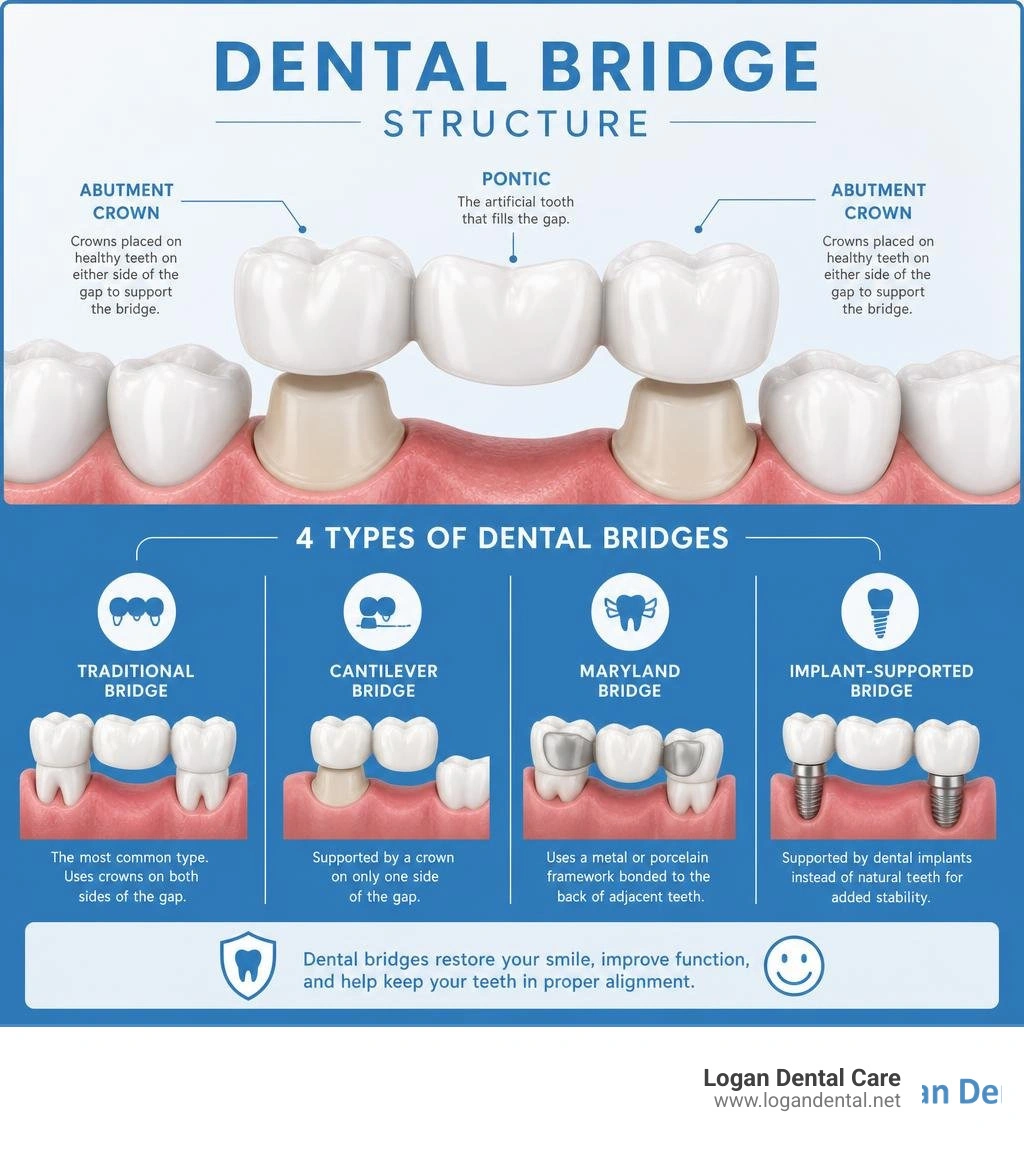
Simple tooth bridge glossary:
What is a Dental Bridge and How Does It Work?
At its core, a dental bridge is a custom-made prosthetic designed to span the empty space left by missing teeth. The structure relies on two main components:
- The Pontic: This is the artificial replacement tooth (or teeth) that sits directly in the gap. Pontics are typically crafted from high-quality porcelain or ceramic to mimic the natural translucency and shade of your surrounding teeth.
- The Abutments: These are the anchor points. In a traditional setup, your natural teeth on either side of the empty space serve as the abutments. We prepare these teeth and cover them with custom dental crowns to support the pontic in the middle.
When you lose a permanent tooth, the surrounding bone stops receiving the chewing stimulation it needs, which can cause the jawbone to shrink over time. Furthermore, teeth like to have neighbors. Without a physical "bookend" to keep them in place, the teeth adjacent to the empty space will naturally drift, tilt, or shift into the gap. This shifting can throw off your bite alignment, cause jaw joint pain, and make normal chewing difficult.
By placing a custom-engineered bridge in mouth, we physically lock your remaining teeth in their proper positions, distributing chewing forces evenly across your bite. For more details on clinical candidacy, you can read the resource on Dental Bridges: Types & Who Needs Them.
Signs You May Need a Tooth Bridge
How do you know if a tooth bridge is the right step for your smile? Here are the most common warning signs we look for during exams in our Bellefontaine office:
- Difficulty Chewing: If you find yourself shifting food to one side of your mouth to avoid a gap, your bite is working twice as hard as it should.
- Visible Tooth Decay or Damage on Neighboring Teeth: If a tooth next to a gap is heavily decayed or broken, a bridge can serve a dual purpose: replacing the missing tooth while reinforcing the damaged neighbor with a protective crown.
- Shifting Teeth: If you notice new gaps forming between other teeth, or if your teeth seem to be tilting inward toward an old extraction site, it is a sign your bite is losing its structural stability.
Exploring Your Tooth Bridge Options
Modern dentistry does not believe in a one-size-fits-all approach. Depending on the location of your missing tooth, the health of your remaining teeth, and your lifestyle goals, we can choose from several distinct teeth bridge options.
We evaluate your smile using digital diagnostics to select the safest, most stable design among the primary fixed partial denture options available today.
Traditional and Cantilever Bridges
The traditional dental bridge is the most common type used in restorative dentistry. It requires healthy natural teeth on both sides of the gap to act as anchors. To place the supporting crowns, we must gently reshape the anchor teeth by removing a small amount of outer enamel. While this is an irreversible step, it ensures the crowns fit seamlessly over your teeth.
A cantilever bridge, on the other hand, is used when there is a healthy anchor tooth on only one side of the gap. Because it is supported by a single anchor, it acts like a bracket. While highly useful in specific scenarios, cantilever designs are structurally weaker than traditional bridges and are generally avoided in the back of the mouth where chewing forces are heaviest. You can read more about the physics of these dental designs on the Wikipedia page for Bridge (dentistry)).
Maryland and Implant-Supported Bridges
If you are looking for a more conservative option that preserves your natural tooth enamel, a Maryland bonded bridge might be the answer. Instead of using full-coverage crowns, a Maryland bridge uses a pontic supported by thin metal or porcelain "wings" bonded discreetly to the backs of your adjacent teeth. Because they do not require aggressive tooth shaping, they are an excellent, conservative option — particularly for replacing front teeth in younger patients whose jaws are still developing.
For patients missing multiple teeth in a row, an implant-supported bridge offers unmatched stability. Rather than relying on your natural teeth, this option anchors the bridge directly to titanium posts placed in your jawbone. This is highly effective for longer spans, such as a 5 tooth bridge, because it replaces multiple teeth without putting extra physical stress on your natural teeth.
In highly specific clinical cases involving severe gum disease, researchers have even successfully utilized a patient's own extracted tooth as a natural pontic bonded with fiber-reinforced composites to stabilize mobile teeth, as highlighted in this study on the Reconstruction of Natural Smile and Splinting with Natural Tooth Pontic Fiber-Reinforced Composite Bridge - PMC.
The Dental Bridge Procedure and Recovery Timeline
Getting a dental bridge is a highly structured process that we carefully design to be as comfortable and stress-free as possible. While we do not offer sedation dentistry at Logan Dental Care, we utilize advanced local anesthesia to ensure you do not feel pain during the preparation phase.
The entire process, from your initial consultation to the final placement, typically takes about two to four weeks. Once your permanent bridge is bonded in place, the average recovery time for your teeth and gums to feel completely normal is just one to two weeks.
To help you prepare, we have put together a bridgework teeth complete guide to explain the details, or you can explore our dedicated crowns and bridges service page.
What to Expect During Your Appointments
Your transformation typically takes place over two comfortable visits to our Bellefontaine office:
- The First Visit (Preparation & Impressions): After thoroughly numbing the area with local anesthesia, we gently shape the anchor teeth. We then take precise digital impressions — meaning no messy, uncomfortable putty in your mouth. We place a temporary bridge to protect your prepared teeth and maintain your smile's appearance while our trusted laboratory custom-crafts your permanent restoration.
- The Second Visit (Permanent Placement): Once your custom bridge arrives, you will return to our office. We will remove the temporary bridge, gently clean the area, and try on your new permanent bridge. We meticulously check the fit, your bite alignment, and the color match before permanently cementing it into place. For a deeper look at this process, check out our slugcrowns bridges complete guide.
Comparing a Dental Bridge vs. Dental Implant
When deciding how to replace a missing tooth, the biggest question most patients face is whether to choose a dental bridge or a dental implant. Both are fantastic restorative solutions, but they function very differently.
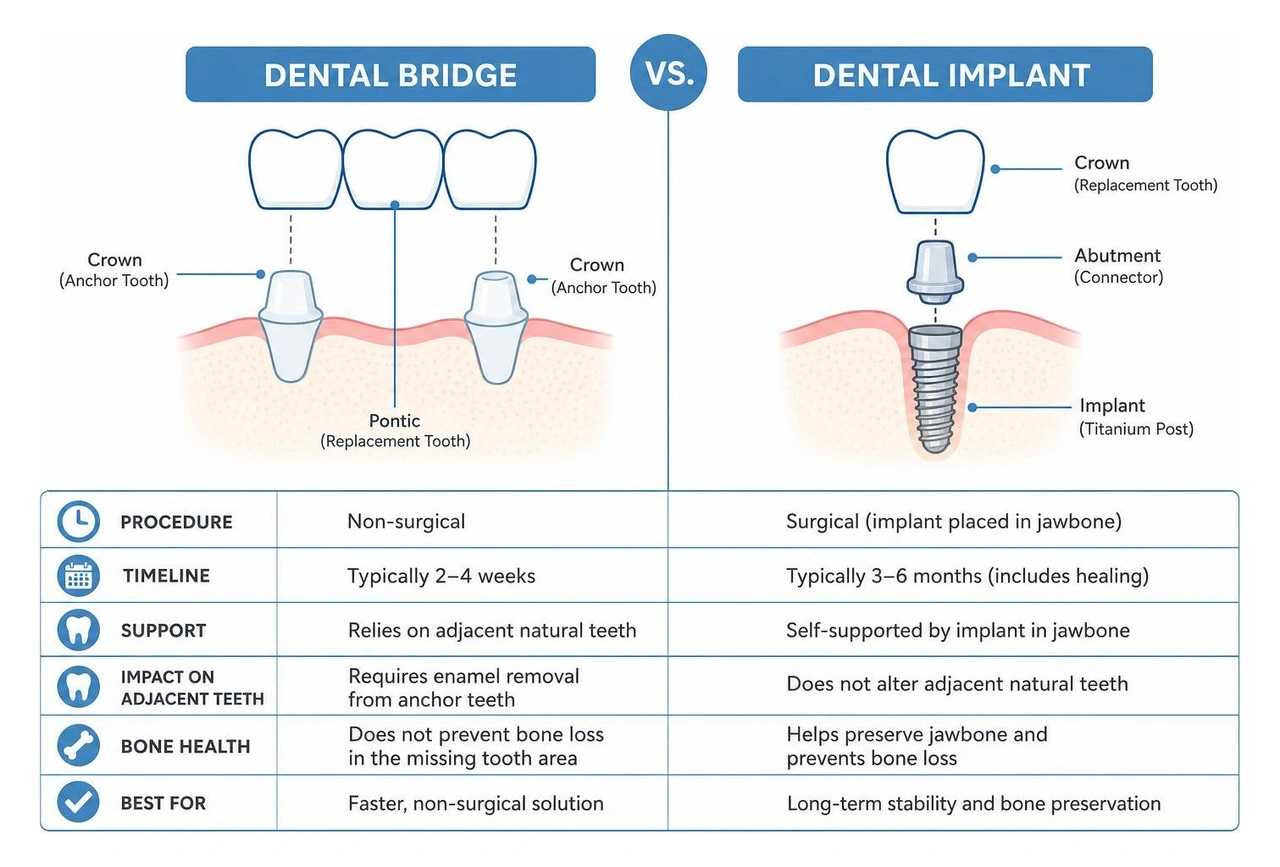
A dental bridge is a non-surgical, faster option that relies on surrounding teeth for support. A dental implant, however, is a surgical solution where a titanium post is placed directly into the jawbone to act as an artificial tooth root. Over a period of three to six months, a process called osseointegration occurs, where the bone physically fuses with the implant.
While implants take longer and require surgery, they stand completely independently, meaning we do not have to alter your adjacent healthy teeth. They also actively prevent long-term jawbone loss. To weigh these factors for your unique smile, read our breakdown on dental implants vs bridges which tooth replacement option is best for you or visit our dental implants page.
Choosing the Best Tooth Bridge for Your Smile
The right choice for your smile depends on several personal and clinical factors:
- Jawbone Density: Implants require healthy bone to anchor into. If you have experienced bone loss, a bridge may be the safer, more practical choice.
- Timeline: A bridge is completed in a few weeks, whereas implants require several months of healing.
- Adjacent Tooth Condition: If the neighboring teeth already have large fillings or decay, they can actually benefit from being capped with the crowns of a traditional bridge. If they are perfectly healthy, you may prefer an implant to avoid altering them. Explore your options further with our guide on implant options for missing teeth.
Lifespan, Care, and Maintenance of Dental Bridges
A major advantage of a tooth bridge is its immediate durability and natural feel. Once placed, it feels just like your natural teeth — much like getting used to wearing a new ring on your finger.
On average, the lifespan of a dental bridge is five to 15 years. However, with regular professional cleanings and excellent home care, many bridges easily last over 10 years.
Caring for Your Bridge
To maximize the lifespan of your restoration, we recommend incorporating these simple habits into your daily routine:
- Daily Brushing: Brush at least twice a day using a soft-bristled toothbrush and a nonabrasive fluoride toothpaste to keep the porcelain clean and protect the natural tooth margins underneath the crowns.
- Specialized Flossing: Because a bridge is a single connected unit, you cannot floss straight down between the teeth. You must use specialized floss threaders or interproximal brushes daily to slide underneath the pontic and clear away food debris and plaque.
- Dietary Precautions: Avoid chewing on extremely hard or sticky items, such as ice, hard candies, or raw bones, which can crack the porcelain or weaken the dental cement.
- Regular Checkups: Keep up with your routine cleanings and exams. This allows us to monitor the margins of your bridge and catch any minor issues before they turn into major problems. Learn more about keeping your whole mouth healthy on our family dentistry page or read our article on maintaining a bridge for teeth.
Dental Bridge Cost and Financial Considerations
We believe in complete, upfront transparency when it comes to the cost of your dental care. While we do not publish specific pricing because every smile requires a highly customized plan (depending on the number of teeth being replaced, the health of your anchor teeth, and your material selection, such as zirconia or lifelike porcelain), we are always happy to provide a clear, detailed estimate before any treatment begins.
For general context on restorative costs, you can read our dental crowns cost complete guide.
To keep our care honest and straightforward, we want to be completely upfront: At this time, Logan Dental Care does not offer in-house payment plan options, and we do not offer sedation dentistry. However, we accept most major dental insurance plans, and 99% of patients are approved for flexible, third-party financing options (such as CareCredit) to help make your care manageable. We also offer our in-house Smile Protection Savings Plan for patients without insurance to help keep preventive and restorative care accessible.
Frequently Asked Questions About Dental Bridges
Is getting a dental bridge painful?
No, the procedure itself should not hurt. We use local anesthesia to completely numb your teeth and gums before we begin shaping the teeth. After the numbness wears off, you may experience some mild sensitivity or post-procedure tenderness in your gums for a few days, but this is highly manageable with over-the-counter pain relievers.
Can a dental bridge be removed and recemented?
If a bridge simply becomes loose but is otherwise in perfect structural condition, we can often easily remove, clean, and recement it. However, if the bridge must be removed to treat new decay on the anchor teeth underneath, the removal process will likely break the bridge, meaning a complete replacement will be necessary.
What is the ideal age for a dental bridge?
Because a bridge relies on stable bone structure, dentists typically do not place permanent dental bridges in patients younger than 17 or 18 years old. Before this age, a teenager's jaw is still growing, and placing a fixed bridge could disrupt natural jaw development. Temporary space maintainers or Maryland bridges are often used for younger patients experiencing pediatric tooth loss.
Conclusion
Replacing a missing tooth is about so much more than just cosmetics — it is about protecting your bite, preserving your natural teeth, and reclaiming your confidence. Whether you are considering a traditional tooth bridge or exploring other tooth replacement options, our family-focused team at Logan Dental Care is here to guide you every step of the way.
We are proud to serve families across Bellefontaine, Zanesfield, West Liberty, Russels Point, and the surrounding Logan County communities with comfortable, personalized care.
Ready to restore your smile? Contact us today to schedule your consultation, or visit our dentures page to learn about alternative missing teeth solutions!