
A Quick Start Guide to Comparing Partial Denture Options

Why So Many People Are Exploring Partial Denture Options Right Now
Partial dentures are removable dental appliances that replace multiple missing teeth — while keeping your healthy teeth in place.
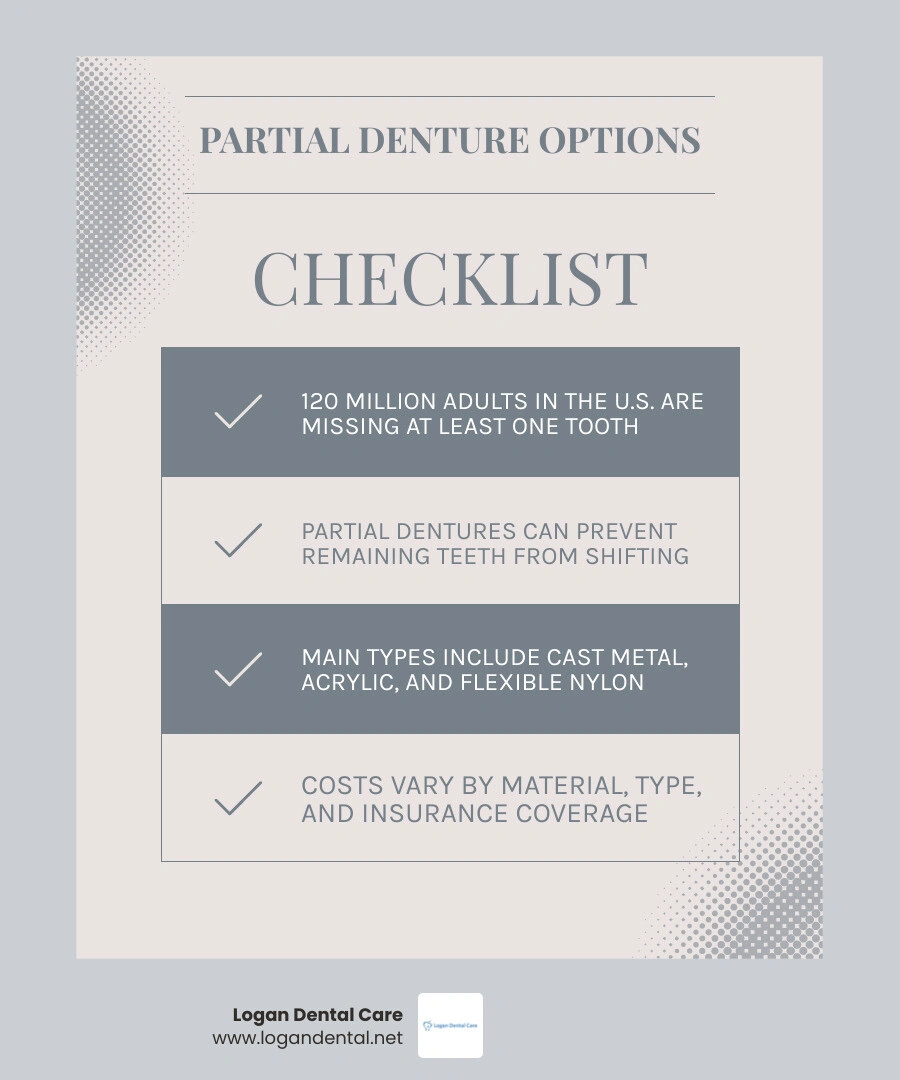
Here's a quick look at what you need to know:
- What they are: Custom-made replacements for one or more missing teeth, held in place by clasps or attachments on your remaining teeth
- Who needs them: Anyone missing several teeth but still has healthy teeth remaining in the upper or lower jaw
- Main types: Cast metal, acrylic plastic, and flexible nylon — each with different trade-offs in comfort, durability, and appearance
- How they help: Restore chewing and speech, prevent remaining teeth from shifting, and support your confidence
- What they cost: Costs vary based on material, type, and insurance — but options exist at a range of price points
You're not alone if you're figuring this out for the first time. An estimated 120 million adults in the United States are missing at least one tooth. For many of them, a partial denture is the most practical path back to a fully functioning smile.
But not all partials are the same. The right choice depends on your mouth, your lifestyle, and your goals — and the options can feel overwhelming at first.
That's exactly why we put this guide together. Here at Logan Dental Care, we want to help you walk into your consultation feeling informed and confident — not confused.
Partial dentures glossary:
What Are Removable Prosthetics and Who Needs Them?
When you lose a tooth due to decay, injury, or natural aging, the empty space left behind is more than just a cosmetic concern. Your teeth work as a team. When one member of the team goes missing, the surrounding teeth lose their support system and can begin to drift out of alignment. This shifting can lead to uneven bite pressure, jaw joint pain, and difficulty chewing your favorite foods.

A removable partial denture is designed to step into these gaps, restoring both the function and structure of your bite. If you have three or more missing teeth in a row, or several gaps throughout an arch, a partial denture is often the most straightforward and non-invasive way to get your smile back on track. By filling these spaces, you prevent long-term complications and keep your remaining natural teeth stable and healthy. You can learn more about the consequences of leaving gaps unfilled in our guide to missing teeth.
Understanding the Anatomy of Partial Dentures
To understand how these appliances work, it helps to know what they are made of. A standard partial denture consists of custom-manufactured replacement teeth attached to a pink, gum-colored acrylic base. This base is designed to mimic the natural look of your gums.
To keep the appliance secure while you eat and speak, it relies on support from your remaining healthy teeth. This connection is typically made using either metal clasps that wrap around your adjacent teeth, or precision attachments. Precision attachments are customized, slide-in connectors that are much less visible than metal clasps but often require placing protective crowns on the supporting teeth to ensure a perfect fit. For a deeper look at how these appliances are designed, you can read the official scientific research on partial dentures provided by the American Dental Association.
Comparing Your Options: Materials and Types
Choosing the right material for your partial denture is a highly personal decision. The material you select will influence how heavy the denture feels, how natural it looks, and how long it lasts.
Our goal is always to find the perfect balance between comfort, durability, and aesthetics for your unique mouth. For more information on finding the right fit for your budget, check out our insights on affordable partials.
Cast Metal vs. Acrylic Plastic Dentures
For decades, the cast metal partial denture has been a reliable standard in restorative dentistry. These appliances feature a lightweight, highly durable framework typically made from a strong cobalt-chromium alloy. They are incredibly thin and strong, which means they cover less of the sensitive soft tissues in your mouth. This lower profile helps keep your speech natural and makes eating a comfortable experience.
While titanium is occasionally used for its strength, a small fraction of the population — about 0.6 percent according to a 2017 research review — can experience mild inflammatory reactions to titanium. For patients with known metal sensitivities, or those looking for a temporary solution, acrylic plastic dentures (often called "flippers") are a common alternative. Acrylic partials are thicker and less durable than metal-based options, but they are highly cost-effective and easy to repair. They are frequently used as temporary appliances while gums heal. If you are replacing teeth in a highly visible area, you might find our article on whether a top front teeth option is right for you helpful.
The Benefits of Flexible Partial Dentures
If you are looking for an option that prioritizes comfort and completely eliminates visible metal clasps, flexible partial dentures are an excellent choice. Made from a specialized, biocompatible thermoplastic nylon resin, these appliances are lightweight and designed to flex slightly as you chew.
Because they are translucent, your natural gum color shows through the material, making the clasps virtually invisible. They are also a wonderful alternative for patients with metal or acrylic allergies. To get the best fit out of a flexible partial, dentists often recommend warming the appliance in warm water for about one minute before putting it in your mouth. This simple step helps the nylon mold perfectly to your gums. You can explore a detailed comparison of these materials in this guide on denture types.
The Process of Getting, Adjusting to, and Comparing Your New Smile
Getting a partial denture is a collaborative process that takes place over a few visits to our Bellefontaine office. We start by taking highly accurate digital scans or physical impressions of your mouth to map out your unique bite.
If you have recently had a tooth extracted, your gums and jawbone will need time to settle. It typically takes about six months for the tissues to fully heal and reshape after an extraction before a permanent, custom-fitted partial denture can be crafted. During this waiting period, we can provide a temporary appliance so you never have to go without your smile.
What to Expect During Your Fitting and Adjustment Period
When you first place your new partial denture in your mouth, it is completely normal for it to feel bulky, awkward, or even slightly tight. Your tongue and cheek muscles have to learn how to work around the new appliance.
During the first few weeks, we recommend practicing these simple steps:
- Practice insertion: Gently place the denture in with your fingers. Never bite down to force the appliance into place, as this can bend or snap the clasps.
- Start with soft foods: Cut your meals into small, bite-sized pieces and practice chewing evenly on both sides of your mouth to balance the pressure.
- Read out loud: If you notice a slight lisp, read a book or newspaper out loud to help your tongue adjust to the new shape of your teeth.
- Wear it consistently: Initially, wearing your partial as instructed is the fastest way to identify any localized "sore spots" so we can professionally adjust the fit for you.
Comparing Partials to Fixed Bridges and Dental Implants
While removable partials are a fantastic, non-surgical way to replace missing teeth, they aren't the only option available. It is always wise to compare them against fixed restorations.
A fixed dental bridge is permanently anchored to the healthy teeth on either side of the gap using custom crowns. Unlike a partial, a bridge cannot be removed at night. For those looking for the ultimate standard in stability, dental implants utilize titanium posts surgically placed into the jawbone to act as artificial tooth roots. Implants look and function exactly like natural teeth and prevent the bone loss that naturally occurs when teeth are missing.
To explore these permanent alternatives, take a look at our guides on fixed options, our complete guide to bridgework, and our overview of permanent replacements.
Frequently Asked Questions About Partial Dentures
How much do partial dentures cost and does insurance cover them?
The total cost of a partial denture depends entirely on the materials you choose, how many teeth need to be replaced, and the amount of custom fabrication required. Because partial dentures restore your ability to chew and speak properly, most dental insurance plans view them as essential restorative treatments and will cover a significant portion of the cost.
We always recommend checking your insurance plan's "Explanation of Benefits" or speaking with our front desk team before starting treatment so we can help you maximize your coverage. To help you understand how different designs impact overall value, you can read more about the various types of partial dentures and review general industry guides on denture costs and insurance coverage.
How do I clean and care for my partial dentures?
Keeping your appliance clean is vital for protecting both the denture and your remaining natural teeth. Standard toothpaste is actually highly abrasive and can leave microscopic scratches on your denture, which quickly become breeding grounds for bacteria.
Instead, follow these simple care steps:
- Handle with care: Always clean your dentures over a folded towel or a sink filled with water. If you accidentally drop them, the water or towel will cushion the fall and prevent the plastic from cracking.
- Brush daily: Use a soft-bristled brush or a specialized denture brush with mild hand soap, dishwashing liquid, or a non-abrasive denture paste.
- Soak overnight: Remove your partials before going to sleep to give your gums a chance to rest. Soak them in plain water or an approved overnight cleaning solution to keep them from drying out and losing their shape.
For more detailed maintenance tips, read our comprehensive denture care advice.
Can my partial dentures be repaired if they break or become loose?
Yes, but they must be repaired by a professional. Over time, your jawbone and gum ridges will naturally shrink and change shape. This natural shifting means your partial may begin to feel loose or slip when you chew.
In fact, a historical research review showed that an estimated 39 percent of removable partial dentures were no longer in use five years after they were made, often because patients did not return for adjustments when their mouths naturally changed. If your denture breaks, cracks, or loses a tooth, do not attempt to fix it yourself with over-the-counter household glues. These glues often contain toxic chemicals that are unsafe for oral use and can ruin the appliance beyond repair. Instead, contact us immediately so we can safely adjust or repair your denture. You can also read about how other practices handle restoring missing teeth to see how common professional maintenance is.
Conclusion
At Logan Dental Care, we believe that replacing missing teeth should be a comfortable, stress-free experience. We are proud to serve families throughout Bellefontaine, Ohio, and surrounding Logan County communities like Zanesfield, West Liberty, and Russels Point. We treat every patient who walks through our doors at 1021 N. Main Street like a member of our own family.
We want to be completely transparent: at this time, we do not offer payment plans, and we do not offer sedation dentistry. We believe in providing clear, upfront information so you can make the best, most comfortable decisions for your family's oral health.
If you are ready to explore your options and find a solution that helps you eat, speak, and smile with confidence again, we invite you to schedule a consultation for dentures with our friendly team. To learn more about our local services, explore our guide on dentures in Bellefontaine.