
Which Dental Implant Type is Your Perfect Match?
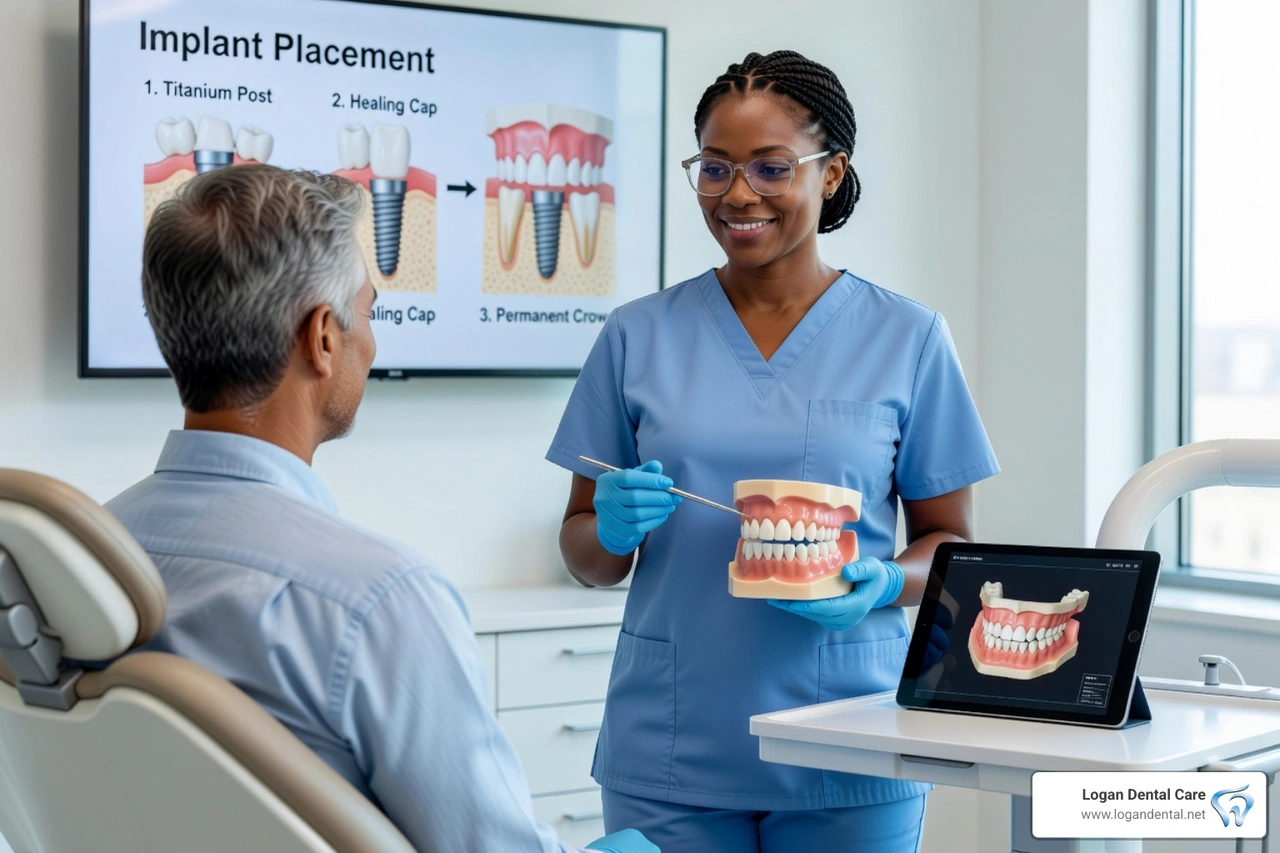
Not All Dental Implants Are the Same — Here's What You Need to Know
The different types of dental implants fall into several main categories, each designed for a specific situation:
Endosteal implants: Best for most patients with a healthy jawbone. These titanium posts are placed directly into the bone.
Subperiosteal implants: Best when jawbone volume is limited and bone grafting is not preferred. A metal frame rests on top of the jawbone.
Zygomatic implants: Best for severe bone loss in the upper jaw. These anchor into the cheekbone instead.
Mini dental implants: Best for small spaces or stabilizing dentures. They use a narrower, less invasive design.
All-on-4 / All-on-6: Best for full-arch tooth replacement. A full set of teeth is supported by 4 to 6 implants.
Immediate load implants: Best for patients with strong bone density who want faster results. Temporary teeth may be placed the same day.
Missing a tooth — or several — is more common than most people realize. In fact, roughly 120 million Americans are missing at least one tooth.
Dental implants have become the go-to solution because they do something bridges and dentures simply can't: they replace the root, not just the visible tooth. That matters because your jawbone needs stimulation from tooth roots to stay healthy. Without it, bone slowly breaks down over time.
But here's what surprises many people walking into a dental office for the first time: not all implants work the same way, and what's right for your neighbor may not be right for you.
Your bone density, how many teeth you're missing, your overall health, and even your budget all play a role in which option fits best. The good news? There are more choices than ever — and one of them is almost certainly a good match for your situation.
This guide walks you through each type clearly, so you can walk into your consultation at Logan Dental Care already knowing what questions to ask.

The 4 Primary Categories of Different Types of Dental Implants
When we talk about the different types of dental implants, we are usually referring to where the implant is placed and how it interacts with your anatomy. At Logan Dental Care, we believe that understanding your options is the first step toward a confident smile.
The core of implant technology is a process called osseointegration. This is a fancy way of saying that the implant material (usually titanium) actually fuses with your living bone. This creates a rock-solid foundation that mimics a natural tooth root. However, the way we achieve that foundation depends heavily on your bone density and jaw structure.
For more details on how these fit into the local landscape, check out our Dental Implants Logan County Guide.
Endosteal Implants: The Most Common Different Types of Dental Implants
If you have a healthy jawbone and are looking to replace one or more teeth, you are likely looking at an endosteal implant. These are the "gold standard" of the industry and the most frequently used type worldwide.
Endosteal implants are typically shaped like small screws, cylinders, or blades. They are surgically placed directly into the jawbone. Because they are nestled right in the bone, they provide the strongest and most natural-feeling support for a crown or bridge.
These are particularly popular for front teeth because they offer excellent aesthetic results and mimic the way a natural tooth emerges from the gum line. You can learn more about this in our Dental Implants Front Teeth Complete Guide.
- Pros: Extremely durable, high success rates (95-98%), and prevents bone loss.
- Best For: Patients with adequate bone density and good overall health.
Subperiosteal Implants for Limited Jawbone
What happens if your jawbone isn't quite thick enough for a screw to be inserted? In the past, this meant you might not be a candidate for implants at all. Today, we have subperiosteal implants.
Unlike endosteal implants that go into the bone, subperiosteal implants sit on top of the bone but still underneath the gum tissue. A metal framework is custom-fitted to the contour of your jaw. Posts from this framework protrude through the gums to hold the prosthetic teeth in place.
While these are less common today due to advancements in bone grafting, they remain a vital alternative for patients who cannot undergo bone augmentation or who have a very shallow jawbone. If you've wondered about the safety of these procedures, we have a resource on Are Tooth Implants Safe that covers the rigorous standards we follow.
Zygomatic Implants: The Cheekbone Alternative
Zygomatic implants are the most complex of the different types of dental implants. They are used almost exclusively for the upper jaw when there is severe bone loss—so much so that even a subperiosteal implant or a bone graft won't work.
Instead of anchoring into the jawbone, these extra-long implants (sometimes up to 55mm!) anchor into the zygomatic bone, better known as your cheekbone. Because the cheekbone is incredibly dense and does not recede like the jawbone, it provides a stable anchor for a full set of upper teeth.
This procedure is highly specialized and is often a life-changing solution for patients who have been told by other dentists that they simply don't have enough bone for implants.
Mini Dental Implants for Small Spaces and Denture Stability
Think of mini dental implants (MDIs) as the "toothpick" version of traditional implants. They have a much narrower diameter (usually less than 3mm).
We often recommend Implants for Teeth in the "mini" variety for two specific reasons:
- Tight Spaces: If you are missing a small tooth (like an incisor) and the gap is too narrow for a standard implant.
- Denture Stabilization: MDIs are fantastic for "locking" a lower denture into place, preventing it from sliding around while you eat or speak.
MDIs are less invasive, require less healing time, and can sometimes be placed without complex surgery. However, because they are smaller, they can't always handle the same heavy chewing forces as a full-sized endosteal implant.
Specialized Techniques for Full-Arch Restoration
If you are missing all your teeth in the upper or lower jaw, the thought of getting an individual implant for every single tooth might sound exhausting (and expensive). Thankfully, modern dentistry has developed techniques to restore an entire smile using just a few strategically placed posts.
All-on-4 and All-on-6 Systems
The All-on-4 technique is a approach for edentulous (toothless) patients. Instead of 8 or 10 implants, we use just four. Two are placed straight in the front, and two are placed at an angle in the back. This angled placement allows us to use the densest part of your bone and often avoids the need for a bone graft.
The result? A permanent, non-removable bridge that looks and acts just like natural teeth. If you have a particularly strong bite or a larger jaw, we might recommend an All-on-6 system, which adds two extra implants for increased stability. This is a popular choice for Permanent Teeth Replacement Options Without Dentures.
Implant-Supported Bridges vs. Traditional Options
A traditional bridge requires us to grind down the healthy teeth next to a gap to act as anchors. We aren't big fans of touching healthy teeth if we don't have to!
An implant-supported bridge uses implants as the anchors instead. This preserves your natural teeth and provides a much stronger bite. When looking at Dental Implants vs Bridges: Which Tooth Replacement Option is Best for You, the implant version almost always wins on longevity and bone health.
3-on-6 Implants for Maximum Stability
For those who want the absolute gold standard in full-mouth restoration, the 3-on-6 system is an incredible option. It uses six implants to support three separate dental bridges.
Unlike a "hybrid" denture (like All-on-4) that might have a small acrylic "gum" portion, 3-on-6 implants look and feel exactly like natural teeth because they don't cover the roof of your mouth or use any artificial gum tissue. It’s a way to Never Hide Your Smile Again: Permanent Teeth Replacement with Dental Implants while maintaining the highest level of comfort.
Comparing Materials and Procedural Approaches
Choosing the right implant isn't just about the "type"—it's also about what it's made of and how we put it in.
Titanium vs. Zirconia Materials
For decades, titanium has been the "gold standard." It's incredibly strong, lightweight, and biocompatible, meaning the body rarely rejects it.
However, for patients with metal sensitivities or those who prefer a "metal-free" holistic approach, zirconia implants are a fantastic alternative. Zirconia is a high-strength ceramic that is naturally white, which can be an advantage if you have thin gum tissue where a dark titanium post might slightly show through.
Single-Stage vs. Two-Stage Procedures
The Tooth Implant Process generally follows one of two paths:
- Two-Stage: We place the implant and stitch the gum over it. After several months of healing, we do a minor second step to uncover the implant and attach the tooth. This is often safer for complex cases.
- Single-Stage: We place the implant and a temporary "healing abutment" that stays visible above the gum line. This saves you from a second surgery.
Immediate Load "Teeth in a Day"
We know that nobody wants to walk around with a gap in their smile for months. In specific cases where the bone is very strong and stable, we can offer "Immediate Load" implants.
This means we place the implant and a temporary crown on the very same day. While you still have to be careful with what you eat while the bone fuses, you can leave our office in Bellefontaine or Logan County with a full smile. Check out our Dental Implants Logan Ohio page for more on local availability of these fast-acting options.
Determining Which Different Types of Dental Implants Suit You
Choosing between the different types of dental implants is a collaborative process. When you visit us at Logan Dental Care, we look at several factors:
- Bone Density: Do you have enough "foundation" for a screw?
- Oral Health: Are your gums healthy? (We have to treat gum disease first!)
- Lifestyle: Do you smoke? (Smoking can lower success rates).
- Goals: Are you looking for a single tooth fix or a total smile makeover?
Preparatory Procedures: Bone Grafting and Sinus Lifts
Sometimes, the "perfect match" for you requires a little prep work. If you've been missing a tooth for a long time, the bone may have thinned out. We can often perform a bone graft or a sinus lift to rebuild that bone.
These procedures are much more routine than they sound and are essential for Dental Implants Improving Oral Health and Facial Aesthetics. By rebuilding the bone, we ensure your implant has a lifetime of support.
Success Rates and Long-Term Maintenance
One of the best things about dental implants is their reliability. Research shows that dental implant surgery has a 90 to 95% success rate, with some studies reporting up to 98%.
How do you stay in that 98%? It’s all about maintenance. You have to treat your implants like natural teeth:
- Brush and floss daily.
- Keep up with professional cleanings (at least twice a year).
- Avoid using your teeth as tools (no opening packages with your smile!).
If you take care of the "root" (the implant), it can last a lifetime. The crown on top might need a refresh every 10 to 15 years, but the foundation is built to stay. For a deep dive into durability, read How Long Do Tooth Implants Last.
Cost Factors for Different Types of Dental Implants
While we don't list specific prices here (as every mouth is different!), it is important to understand what goes into the cost. The total is usually a combination of the implant itself, the abutment (the connector), and the custom-made crown.
Factors that influence the price include:
- The need for extractions or bone grafts.
- The material used (Titanium vs. Zirconia).
- The number of teeth being replaced.
We always provide transparent, line-item estimates so you know exactly what to expect. You can find more general information on our Cost of Dental Implants Per Tooth page.
Frequently Asked Questions about Dental Implants
Are dental implants painful and what is the recovery like?
This is the number one question we get! Most patients are pleasantly surprised to find that the procedure is much easier than they expected. We use local anesthesia to completely numb the area, and we offer sedation options for those who feel a bit nervous.
Afterward, you might feel some minor swelling or "tightness," similar to what you'd feel after a filling or a simple extraction. Most of our patients are back to their normal routine within a day or two.
Who is the ideal candidate for dental implants?
The ideal candidate has:
- Good overall health.
- Healthy gums (no active periodontal disease).
- Enough bone to support the implant (or a willingness to have a graft).
- A commitment to good oral hygiene.
Even if you have health challenges like diabetes, you can often still get implants as long as your condition is well-managed.
How do I choose the right implant dentist?
Experience and technology matter. You want a team that uses 3D imaging (CT scans) to plan your surgery with pinpoint accuracy. But just as importantly, you want a dentist who treats you like a person, not a number.
In our Top Dental Implant Providers in Bellefontaine: A Comprehensive Guide, we talk about the importance of finding a practice that balances modern tech with a warm, community-focused touch.
Conclusion
At Logan Dental Care, we don't just see "cases"—we see neighbors, friends, and families from Bellefontaine, Zanesfield, West Liberty, and all across Logan County. We know that choosing between the different types of dental implants is a big decision, and we are here to make it as comfortable and clear as possible.
Whether you need a single endosteal implant to fill a gap or a full-arch restoration to get your life back, our team is committed to providing high-quality care in an environment that feels like home. We are proud members of the American Dental Association and the Ohio Dental Association, and we bring that expertise to every chair-side conversation.
Ready to find your perfect match? We’d love to meet you. Visit our Dental Implants page to learn more or schedule a consultation today. Let’s build a smile that lasts a lifetime, together.