
Screw It! Your Guide to Dental Implants
What Are Implants for Teeth and How Do They Work?
Implants for teeth are small titanium posts that replace missing tooth roots and support new teeth that look and feel natural.
Quick Answer: What You Need to Know About Dental Implants
- What they are: Small titanium screws placed in your jawbone
- What they replace: Missing tooth roots
- Success rate: Over 95% with proper care
- Timeline: 3-6 months for healing/integration
- Cost: $2,000-$4,000 per tooth
- Lifespan: Can last a lifetime
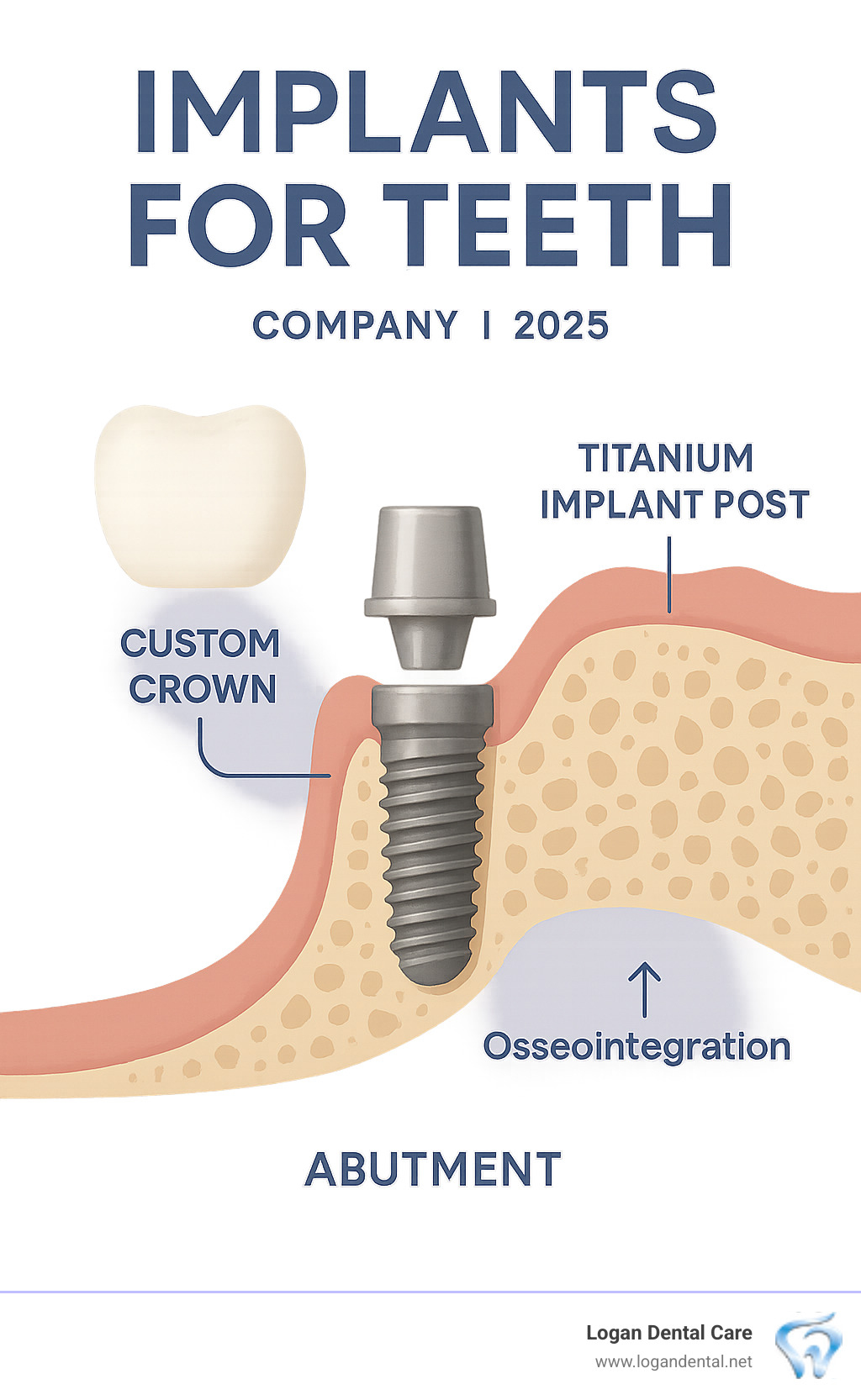
Through osseointegration, your jawbone fuses with the implant, creating a stable foundation. Titanium is biocompatible, which is why your body accepts it so well.
Every dental implant has three parts:
- The implant post – the titanium screw in your jawbone
- The abutment – the connector on top of the post
- The crown – the custom tooth you see when you smile
The A-Z of Getting Implants for Teeth
Getting implants for teeth is a straightforward, staged process. Here's what matters most.
Understanding the Components and Types of Dental Implants
- Implant post: A small screw (commonly titanium; sometimes zirconia) placed in your jawbone to act like a root.
- Abutment: The connector attached to the post, emerging through the gums.
- Crown: The custom-made visible tooth that matches your smile.
Ways we use implants:
- Single tooth replacement: One implant with one crown.
- Implant-supported bridge: A few implants support multiple teeth.
- Implant-supported dentures: Dentures that snap on to implants or are fixed.
- All-on-4 concept: Four to six implants support a full arch; provisional teeth are often placed the same day.
Are You a Candidate? The Role of Jawbone Health
Most healthy adults qualify. Key factors:
- Good oral hygiene and healthy gums
- Adequate jawbone density confirmed by X-rays/3D scans
- Better outcomes for non-smokers
- Well-controlled conditions (e.g., diabetes, osteoporosis)

Not enough bone? Bone grafting can rebuild it; upper jaw cases may need a sinus lift. Bone loss occurs after tooth loss because the jaw is no longer stimulated by chewing.
The Step-by-Step Dental Implant Procedure
- Initial consultation – Exam, X-rays/3D scans, and a custom plan.
- Treatment planning – Exact positioning and any prep (e.g., grafting), plus timeline.
- Implant placement – Post is placed under local anesthesia; sedation is available.
- Healing and osseointegration – Bone fuses to implant (about 3-6 months).
- Abutment placement – Connector is attached after integration.
- Final crown – Impressions are taken and your custom crown is placed.
Typical timeline: 3-9 months (most of it healing). We provide temporary teeth to maintain your smile during healing. For detailed science, see scientific research on the dental implant procedure.
At Logan Dental Care, we pair small-town care with advanced technology to guide you comfortably through each step.
Your New Smile: Benefits, Risks, and Long-Term Care
Choosing implants for teeth restores confidence, function, and long-term oral health.
Why Choose Implants? Benefits Over Dentures and Bridges
FeatureDental ImplantsTraditional BridgesRemovable DenturesStabilityFixed in bone; no movementFixed to adjacent teethRemovable; can slipBone HealthStimulates bone; prevents lossNo stimulation at missing siteCan accelerate bone lossMaintenanceBrush/floss like natural teethTrickier cleaning under bridgeRemove to clean/soakLongevityPosts can last a lifetime; crowns 10-15+ yearsOften replaced in 5-15 yearsReplace/ reline every 5-8 yearsAdjacent TeethPreserves neighboring teethRequires grinding healthy teethNo prep, but can cause wearDiet RestrictionsEssentially noneSome limitsMany limitsInitial CostHigher upfrontModerateLower
Implants look and feel natural, protect nearby teeth, and help maintain facial structure by preventing bone loss. They restore strong chewing and clear speech—often with no diet restrictions.
Success Rates and Potential Risks of Implants for Teeth
Implants for teeth have a success rate over 95% with good planning and care. Health, an experienced team, and hygiene are key. See scientific research on dental implant success.
Potential (uncommon) risks:
- Infection at the site – minimized with hygiene and aftercare.
- Nerve damage – rare; avoided with precise 3D planning.
- Sinus problems (upper jaw) – mitigated with proper planning/sinus lifts.
- Implant failure – may be linked to smoking, infection, or overload; can often be retried.
- Peri-implantitis – inflammation/bone loss around an implant; largely preventable.

At Logan Dental Care, we use advanced imaging and meticulous protocols to minimize risks and support long-lasting results.
Cost, Insurance, and Caring for Your Implants for Teeth
Typical cost is $2,000-$4,000 per tooth. The implant is often a one-time investment; added procedures (e.g., grafting) and case complexity affect price. Insurance coverage varies; some plans cover parts of treatment. We offer financing options to keep care affordable.
Care is simple:
- Brush twice daily and floss around the implant/gums
- Attend regular check-ups/cleanings (usually twice a year)
- Avoid chewing ice/hard candies; consider a night guard if you grind
- Avoid tobacco for better long-term outcomes
With proper care, your implants for teeth can last a lifetime. Learn more about options—from single teeth to full-arch solutions—on our More info about our dental implant services page. Logan Dental Care in Bellefontaine combines a small-town feel with the latest technology—and treats you like family.