
Orthodontist vs Dentist: Who Should You Trust With Your Smile?

Why Knowing the Difference Between a Dentist and Orthodontist Matters for Your Family's Smile
When it comes to dentist and orthodontist care, many people aren't sure who does what — or who to call first.
Here's the short answer:
Dentist: Focuses on your overall oral health, including routine exams, cleanings, fillings, crowns, and extractions. Most people should see a dentist regularly, often about every 6 months for preventive care.
Orthodontist: Focuses on teeth and jaw alignment. Orthodontists complete an additional 2-3 years of specialist training after dental school, with 3,700+ hours of orthodontic education. They commonly provide braces, clear aligners, and retainers for people with bite or alignment concerns.
The simple rule: See your dentist first for general oral health. See an orthodontist when teeth, bite, or jaw alignment is the concern.
Both professionals play an important role in keeping your smile healthy — and they often work together to get you the best outcome.
This guide breaks down exactly what each provider does, who to see for which concern, and how to know when a referral makes sense — whether you're a parent watching your child's teeth come in, or an adult wondering if it's too late to straighten your smile.
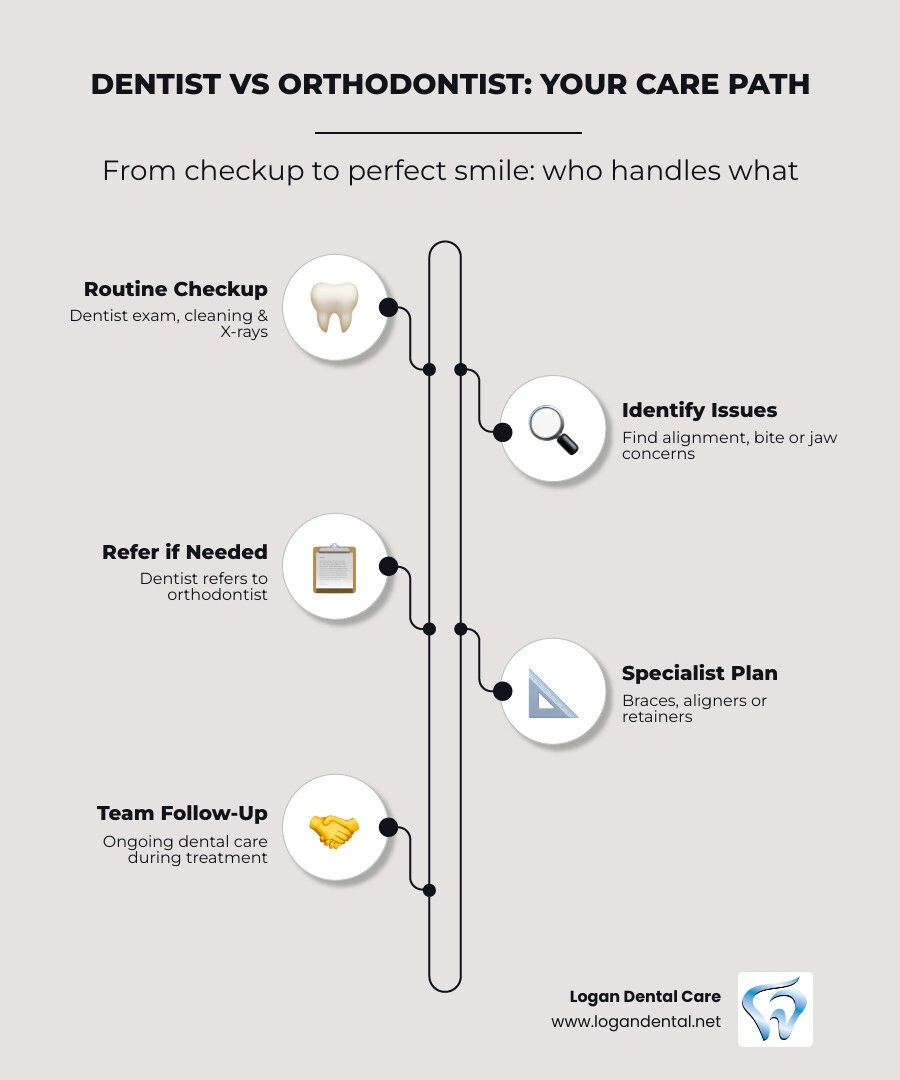
Basic dentist and orthodontist terms:
Dentist and Orthodontist: What’s the Difference?
A general dentist and an orthodontist both care for your mouth, but they do not do the same job.
A general dentist focuses on everyday oral health: keeping teeth and gums healthy, treating decay, repairing damage, and helping prevent future problems.
An orthodontist is a dental specialist who focuses on how teeth fit together, how jaws align, and how teeth move through bone and soft tissue. In other words, if your smile needs steering instead of just maintenance, orthodontics is the lane.
Here is the easiest way to compare them:
A dentist is your go-to provider for general oral health. They help with cleanings, exams, X-rays, cavities, gum issues, tooth pain, broken teeth, fillings, crowns, and long-term preventive care.
An orthodontist focuses on how teeth and jaws line up. They treat crowding, spacing, overbites, underbites, crossbites, and related bite problems using braces, clear aligners, retainers, and other orthodontic appliances.
In simple terms: dentists protect your overall oral health, while orthodontists guide tooth movement and bite correction.
Education and training for a dentist and orthodontist
Dentists typically complete:
- 4 years of undergraduate education
- 4 years of dental school
- Written and clinical licensing exams
Orthodontists complete all of that first, then go on for more specialty training:
- An additional 2- to 3-year orthodontic residency
- More than 4,800 hours of specialized orthodontic training
- About 3,700 hours focused specifically on moving teeth, guiding jaw development, and managing facial structures and soft tissue
That extra training matters. Only about 6 percent of dentists are orthodontists, which tells you this is a true specialty, not just a slightly different job title.
Why orthodontics is a recognized specialty
Orthodontics is recognized as a dental specialty because tooth movement is more complex than it looks. Straightening teeth is not just about appearances. It involves:
- Bite function
- Jaw alignment
- Facial balance
- Bone response to pressure
- Long-term stability after treatment
Orthodontists are trained in dentofacial orthopedics too, which means they may help guide jaw growth in children and teens when needed.
What a General Dentist Does for Everyday Oral Health
General dentistry is the foundation of lifelong oral health. This is the provider most people should see regularly, from young children to grandparents.
At a family practice like ours, general dental care is about much more than fixing problems after they start. It is about preventing trouble, catching concerns early, and helping patients feel comfortable enough to keep coming back. That is half the battle, honestly.

If you want an overview of the care we provide, visit our dental services page.
Common services a general dentist provides
A general dentist may provide:
- Routine exams and cleanings
- Digital X-rays and preventive screenings
- Fillings for cavities
- Crowns to restore damaged teeth
- Bonding for chips or minor cosmetic concerns
- Veneers in appropriate cases
- Treatment for mild gum disease
- Extractions when necessary
- Oral hygiene guidance and preventive education
General dentists are also the first stop for common problems like:
- Toothaches
- Sensitivity
- Bleeding gums
- Persistent bad breath
- Broken or cracked teeth
When to see a dentist first
In most situations, start with a dentist first. That includes if you have:
- Tooth pain
- A chipped or broken tooth
- Signs of decay
- Swollen or bleeding gums
- Questions about routine dental care
- A child who needs regular exams and growth monitoring
A dentist can treat many issues directly and refer to a specialist when needed. That referral process is not a handoff of responsibility. It is teamwork.
What an Orthodontist Does for Tooth and Bite Alignment
Orthodontists focus on straightening teeth and correcting bite problems. They treat issues that affect how your teeth line up, how your jaws fit together, and sometimes how the face develops over time.

If you want a deeper look at this specialty, explore What Do Orthodontists Do and our Orthodontics page.
Common reasons people see an orthodontist include:
- Crowded teeth
- Gaps between teeth
- Protruding teeth
- Overbite
- Underbite
- Crossbite
- Jaw alignment concerns
Orthodontic treatments a specialist provides
Orthodontists may use:
- Traditional braces
- Clear aligners
- Retainers
- Space-maintaining or bite-correcting appliances
- Growth-guidance treatment in younger patients
They also create detailed treatment plans based on how teeth and jaws will move over time. Learn more in these guides:
Signs you may need a dentist and orthodontist on your care team
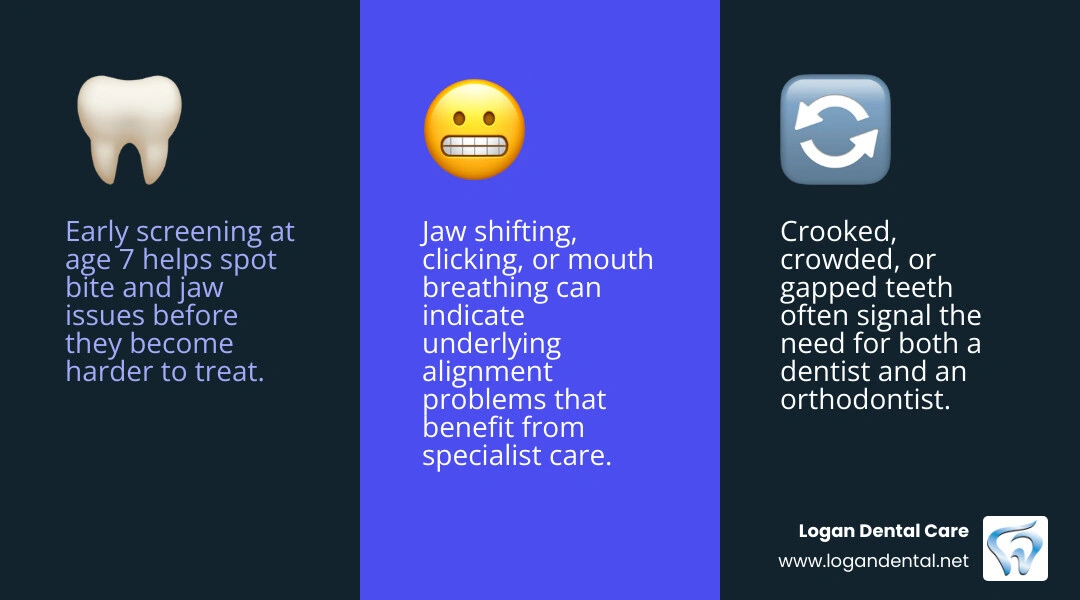
You may benefit from both providers if you or your child have:
- Crooked or crowded teeth
- Noticeable spacing
- Trouble chewing or biting comfortably
- Jaw shifting or clicking
- Mouth breathing
- Speech issues related to tooth position
- Teeth grinding
- A broken bracket, loose wire, or aligner concern
For children, the American Association of Orthodontists recommends a first orthodontic checkup no later than age 7. That does not mean every 7-year-old needs braces right away. It means growth and bite issues can often be spotted early, when planning is easier.
Should You See a Dentist or an Orthodontist First?
Usually, see a dentist first for overall oral health concerns and routine care. See an orthodontist when alignment, bite, or jaw development is the main concern.
In many cases, you do not need to choose one forever. You may need both, just at different times and for different reasons.
When a dentist can help with mild orthodontic needs
Some general dentists can provide limited orthodontic treatment, such as clear aligners or straightforward braces in mild cases. But being able to offer orthodontic treatment does not make a provider an orthodontist.
Mild cases may include:
- Small spacing issues
- Minor crowding
- Limited cosmetic tooth movement
The key is case selection. Simple cases may be manageable in a general practice. More complex bite and jaw problems usually need a specialist.
When a dentist should refer you to an orthodontist
A referral to an orthodontist is a smart next step when there is:
- Significant crowding
- A complex bite problem
- Jaw mismatch
- Impacted teeth
- Shifting after previous orthodontic treatment
- A child with developing bite or jaw concerns
- A need for more advanced planning or appliances
Best practice is straightforward: when the problem falls outside the dentist's scope or comfort zone, a specialist should step in.
Benefits of seeing an orthodontist for alignment issues
There are real advantages to seeing a specialist for tooth and bite alignment:
- More advanced training in tooth and jaw movement
- More precise diagnosis for complex bite issues
- Better long-term stability
- Better understanding of facial growth and balance
- Greater efficiency in treatment planning
- Lower risk of avoidable complications in difficult cases
If you are weighing options, these resources can help:
- Orthodontics 101: A Comprehensive Guide to Straightening Your Smile
- Braces vs Invisalign: Which Orthodontic Treatment is Right for You
Dentist and Orthodontist FAQ
Here are quick answers to common questions about dentist and orthodontist care.
Can a general dentist provide braces or aligner treatment?
Yes, in some cases a general dentist can provide braces or aligner treatment, especially for mild tooth movement. However, that does not make the dentist an orthodontist.
The main difference is training. Orthodontists complete a specialty residency after dental school, while general dentists do not have to complete that additional orthodontic residency. For simple cases, a dentist may be able to help. For more involved alignment or bite problems, a specialist is usually the better fit.
How do dentists and orthodontists work together?
They work together more often than many people realize.
A dentist may:
- Catch the problem first
- Refer for orthodontic evaluation
- Continue cleanings and cavity checks during braces or aligner treatment
- Monitor gum health and general oral health throughout the process
An orthodontist may:
- Evaluate alignment and bite
- Plan and manage tooth movement
- Communicate with the dentist about treatment timing
- Return the patient to routine dental care after active treatment
This coordinated approach helps protect both appearance and health. Straight teeth are great, but straight teeth with untreated cavities are not exactly the dream.
When should a child have a first orthodontic checkup?
The AAO recommends a first orthodontic evaluation by age 7.
That first visit is often about screening, not immediate treatment. It can help identify:
- Early or late loss of baby teeth
- Bite problems
- Jaw growth concerns
- Crowding that may worsen over time
- Mouth breathing or chewing issues
Parents do not always need to wait for a referral. If you notice signs that concern you, it is reasonable to ask about an orthodontic evaluation.
Conclusion: Choosing the Right Care for Your Smile
Understanding the difference between a dentist and an orthodontist makes it easier to get the right care at the right time.
In simple terms:
- See a dentist for routine care, tooth pain, cavities, and overall oral health
- See an orthodontist for crooked teeth, bite problems, jaw alignment concerns, or orthodontic appliance issues
- Expect both providers to work together when your smile needs comprehensive care
At Logan Dental Care, we are proud to serve families in Bellefontaine and throughout nearby communities in Logan County with comfortable, personalized dental care. We believe in treating patients like family, explaining options clearly, and helping you take the next best step without the pressure or confusion.
To learn more about our team, visit Meet the Team. If you are exploring alignment care, you can also find more information about orthodontics services.
If you are not sure whether you should see a dentist or an orthodontist first, start by reaching out. We are always happy to help point your smile in the right direction.