
A Comprehensive Guide to Out-of-Pocket Crown Cost with Dental Insurance

What You May Pay for a Crown With Dental Insurance
The cost of a crown with dental insurance is usually your share of the insurer's allowed fee, not simply half of your dentist's posted price. Crowns are commonly covered as major restorative care, often at 50% after you meet your deductible. Your final bill can be higher when you have little annual benefit left, choose a crown material with an upgrade charge, use an out-of-network dentist, or need related treatment such as a tooth rebuild or root canal.
Before treatment, ask for a written estimate that shows:
- The crown material and procedure code
- Your plan's allowed amount and expected insurance payment
- Any deductible, annual maximum, waiting period, or material downgrade rule
- Separate charges for needed care beyond the crown itself
At Logan Dental Care, our family-focused practice at 1021 N. Main Street in Bellefontaine, Ohio, we aim to make estimates easy to understand. We are accredited members of the American Dental Association and Ohio Dental Association and hold an A+ BBB rating; please note that we do not offer payment plan options or sedation dentistry.
The Logan Dental Care Team will walk through your treatment estimate so you can make a confident decision for your smile and budget.
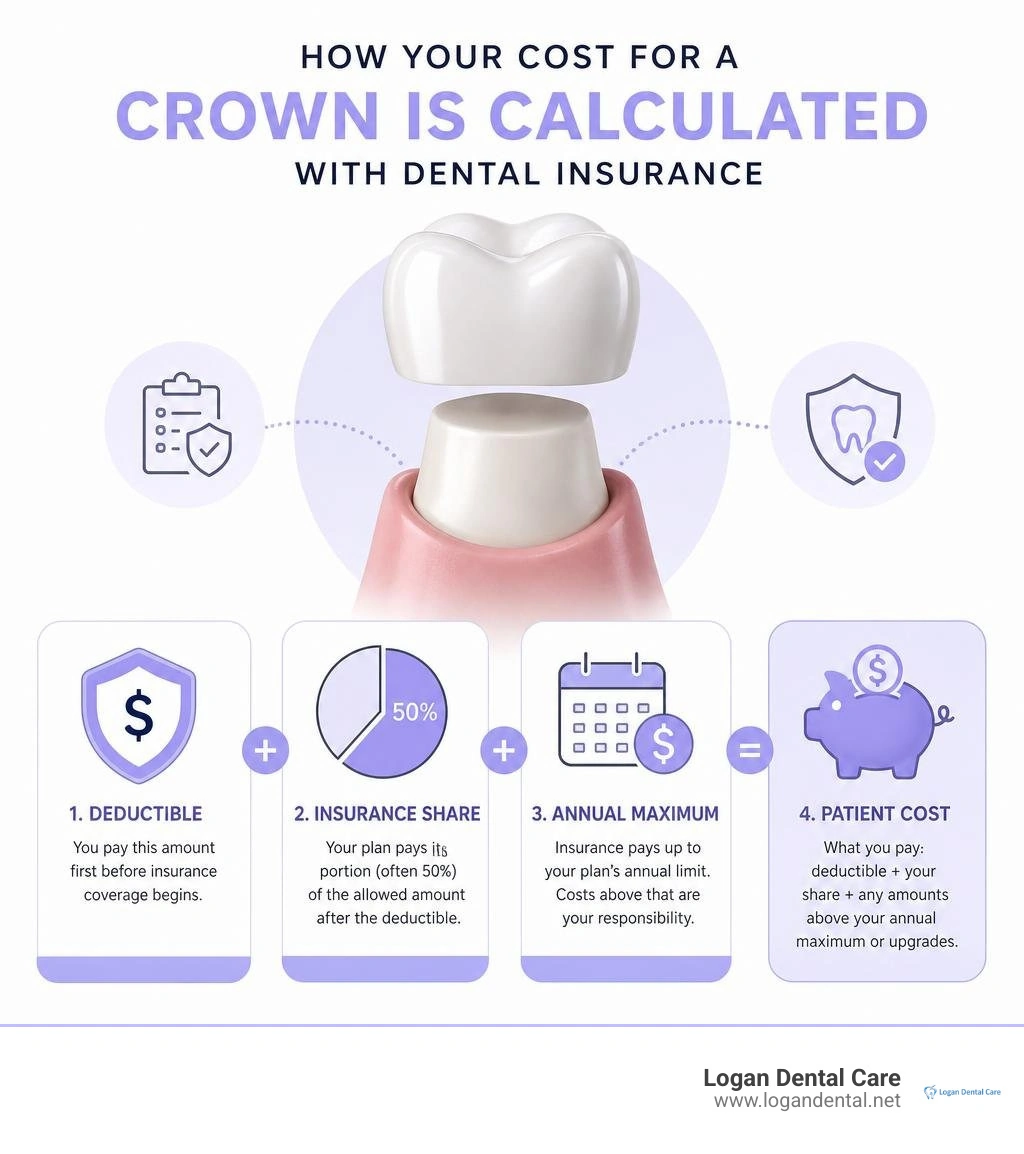
Handy cost of a crown with dental insurance terms:
How Dental Coverage Applies to Restorative Crown Treatment
Dental insurance policies group treatments into distinct tiers: preventive (cleanings, routine checkups), basic restorative (simple fillings), and major restorative care. In the vast majority of benefit plans, dental caps and restorative caps fall squarely under the major service category. This classification generally means your insurance provider shares the cost through a standard coinsurance split, paying around 50% of the allowed fee once you have satisfied your yearly individual deductible.
Our comprehensive services crowns and bridges are designed to repair structural damage, restore chewing power, and protect vulnerable natural teeth from severe fractures. Insurance policies apply strict criteria regarding medical necessity before approving benefits. A crown is typically considered medically necessary when a tooth suffers from extensive decay compromising more than half the natural structure, experiences severe fractures, or requires full coverage following endodontic therapy.
Conversely, cosmetic crowns placed solely to change the appearance of discolored, minorly misshapen, or slightly uneven teeth without structural damage are classified as elective. Cosmetic dentistry is deeply confidence-building—helping you feel vibrant, radiant, and comfortable sharing your smile—but standard insurance plans exclude purely elective cosmetic procedures from coverage, requiring patients to handle the entire expense.
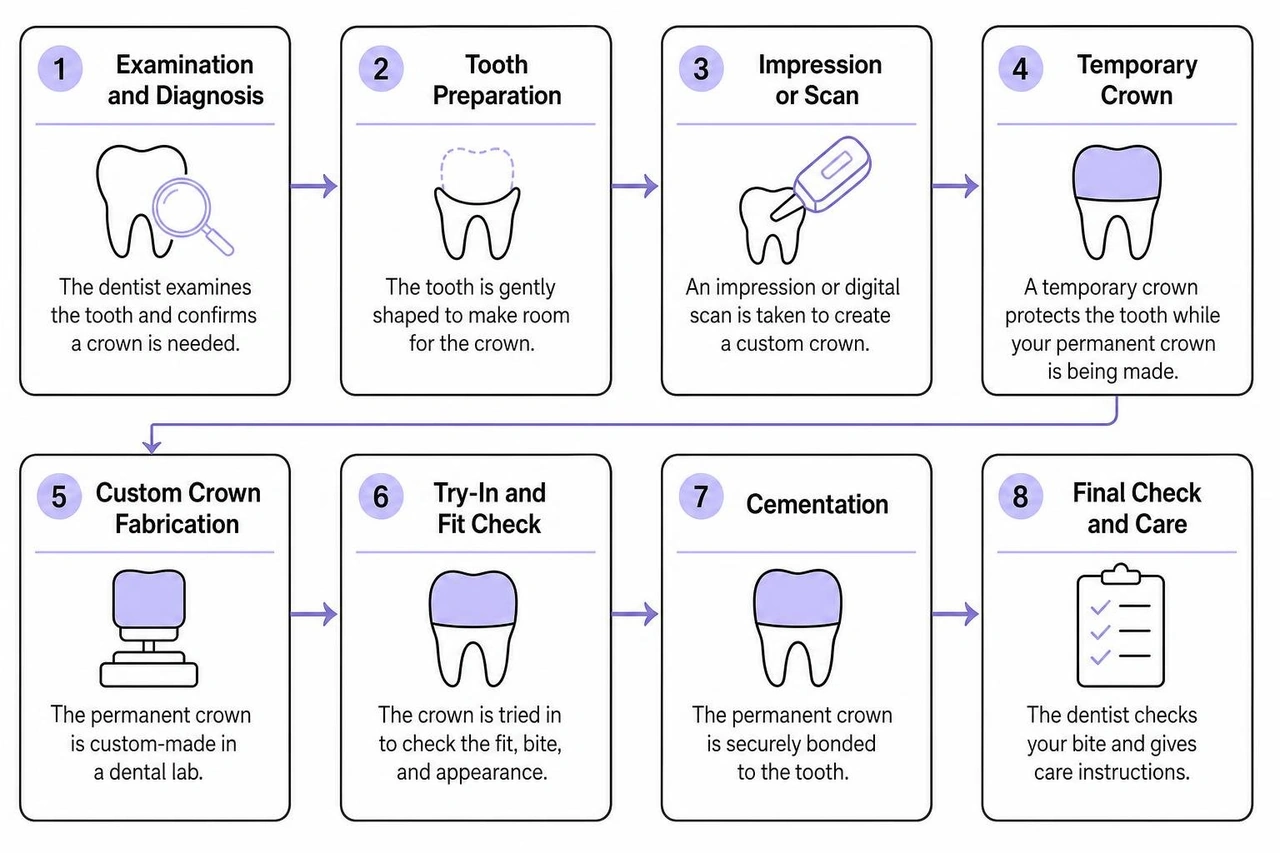
PPO vs DHMO vs Dental Savings Plans
The type of plan you carry shapes your out-of-pocket expenses considerably:
- Preferred Provider Organizations (PPOs): Standard PPO plans allow you to visit any licensed dentist, but visiting an in-network provider ensures you pay a percentage of a lower, pre-negotiated fee schedule. Out-of-network dentists may balance bill you for the difference between their standard fee and what the insurer considers customary.
- Dental Health Maintenance Organizations (DHMOs): These managed-care plans utilize fixed copayment schedules rather than percentage splits. However, coverage is strictly limited to an assigned primary network dentist, offering zero out-of-network benefits.
- In-House Membership Programs: For patients without private coverage, our patients smile protection savings plan provides a transparent, predictable alternative without claim denials, deductibles, or waiting periods.
Key Factors Determining the Cost of a Crown with Dental Insurance
When budgeting for restorative care, your bottom line depends on how several policy rules interact with your tooth's condition. While coinsurance establishes a basic split, the final total reflects your deductible status, annual policy limits, and material choices. Reviewing our dental crowns cost complete guide helps clarify how clinical steps match up with common insurance rules.
Average Out-of-Pocket Cost of a Crown with Dental Insurance by Material
The material used to craft your restoration impacts durability, appearance, and your final copay. For additional context on standard procedural benchmarks, check out this external Guidance on average dental crown prices. Here is how common options compare:
- Porcelain-Fused-to-Metal (PFM): Blends the strength of a metal base with an outer porcelain layer. Often treated as the baseline standard for major restorative benefits.
- All-Ceramic & Porcelain: Highly aesthetic restorations that blend seamlessly with natural enamel, making a ceramic teeth cap a popular choice for visible front teeth.
- Full Zirconia: An exceptionally durable ceramic option capable of withstanding intense biting forces on back molars without chipping.
- Gold and Noble Alloys: Long-lasting restorations that cause minimal wear on opposing enamel, though the high noble metal crown price or a porcelain fused to high noble metal crown cost can fluctuate based on precious metal market rates.
To explore the clinical pros and cons of each restoration type, review our detailed guide on the types of teeth crown and the dental crown options ultimate guide. If you are a heavy clencher or grinder, pairing your restoration with a custom nightguard is a proactive, smart investment that shields both natural teeth and brand-new restorations from premature wear and stress fractures.
The Alternate-Benefit Downgrade Clause
A common surprise in dental benefit contracts is the alternate-benefit or "downgrade" clause. Under this policy rule, if you and your dentist select a premium material like all-ceramic or zirconia for a back molar, your insurer may only calculate its 50% contribution based on the allowed fee for a cheaper porcelain-fused-to-metal (PFM) or cast metal restoration. You remain responsible for your standard coinsurance share plus the entire price difference between the baseline material and your selected upgrade.
Annual Maximums, Waiting Periods, and Preparatory Add-On Costs
Your policy's annual maximum benefit is the total dollar amount your carrier pays toward your dental care within a single calendar or plan year, typically ranging between $1,000 and $2,000. Because major restorative work utilizes a substantial portion of this limit, a single crown—especially when combined with diagnostic cleanings or fillings earlier in the year—can exhaust your available maximum.
Furthermore, individual private insurance plans often enforce waiting periods of 6 to 12 months before major restorative benefits activate. If you need extensive care across multiple teeth near the end of the year, our team can work with you on split-year scheduling, completing one phase in December and the next in January to maximize two separate annual benefit cycles.
Associated Preparatory Procedures
A tooth requiring a crown has often suffered significant damage, meaning additional clinical prep work may be required before the final cap is cemented:
- Core Buildup (CDT D2950): Uses specialized filling material to replace lost tooth structure and create a stable anchor for the restoration.
- Post and Core (CDT D2954): Places a small supportive post inside a root canal treated tooth to provide internal retention.
- Root Canal Therapy: Removes infected nerve tissue from deep within the tooth roots before placing the protective outer crown.
- Diagnostic Imaging: Necessary digital X-rays to assess root stability and bone support.
These essential prep steps carry separate procedure codes and distinct insurance tier classifications. Scheduling a dental crown consultation complete guide gives us the opportunity to evaluate your tooth structure and map out every step in advance.
Whether you are in Bellefontaine, Zanesfield, Valley West Liberty, Logansville, Russells Point, or Lakeview, our team treats you like family, celebrating every patient milestone and staff anniversary as part of our shared Logan County community. Regular preventive checkups remain the ideal starting point for a lasting, low-pressure relationship with our office, catching small issues long before they require complex restorative work.
How to Minimize Expenses and Avoid Hidden Crown Fees
Navigating dental coverage is much simpler when you take proactive steps:
- Request a Pre-Treatment Estimate: We submit planned CDT procedure codes and digital X-rays directly to your insurer before treatment begins to clarify exact allowances and copays.
- Explore Advanced Technology: Learn about modern single-visit options through our guide on dental crown same day solutions.
- Utilize Pre-Tax Health Funds: Maximize tax savings by using Health Savings Accounts (HSAs) or Flexible Spending Accounts (FSAs) to pay for medically necessary out-of-pocket balances.
- Verify Replacement Intervals: Insurance plans usually limit crown replacements on the same tooth to once every 5 to 7 years.
- Learn More About Coverage Terms: Read this helpful resource on Understanding dental crown insurance coverage for broader industry guidance.
If you are paying out of pocket without third-party insurance, ask our front desk about our cash discount dental options, our patients resources, or third-party healthcare financing solutions like patients carecredit. You can also explore how outside healthcare credit functions by reading say goodbye to financial worries affordable dental care credit options and navigating care credit a guide to affordable dental treatments. For general details on tooth caps, explore our articles on the cost of tooth cap and getting a dental cap.
Frequently Asked Questions About Crown Coverage
What is the typical cost of a crown with dental insurance?
Under standard dental PPO plans, a crown is categorized as a major service covered at roughly 50% after you meet your deductible. Your out-of-pocket expense depends on the specific crown material, provider network status, and your remaining annual benefit balance.
Does insurance pay for crowns required after a root canal?
Yes, insurance plans generally cover a dental crown following a root canal as a medically necessary procedure to protect the brittle tooth from cracking. However, because both treatments are completed in the same benefit year, the combined procedures can quickly reach your plan's annual maximum limit.
How do Medicaid and Medicare cover dental crowns?
Original Medicare does not cover routine or restorative dental care like crowns. Some Medicare Advantage plans offer supplemental dental allowances that may help offset restorative costs. Adult Medicaid coverage varies by state and program guidelines, requiring strict medical necessity pre-authorization before restorative crowns are approved.
Conclusion
Understanding your dental benefits helps you make confident, informed choices for your smile. At Logan Dental Care, we are a family-focused dental practice located at 1021 N. Main Street in Bellefontaine, Ohio, dedicated to providing warm, transparent, and high-quality care for our neighbors across Logan County. We are an accredited member of the American Dental Association and the Ohio Dental Association, holding an A+ BBB rating. Please keep in mind that our practice does not offer payment plan options or sedation dentistry. To learn more about your restorative options, explore our dental crowns cost complete guide or contact our friendly team today to schedule your visit!