
Bridging the Gap: Everything You Need to Know About Dental Bridges
Understanding a Bridge in Your Mouth: A Modern Solution for Missing Teeth
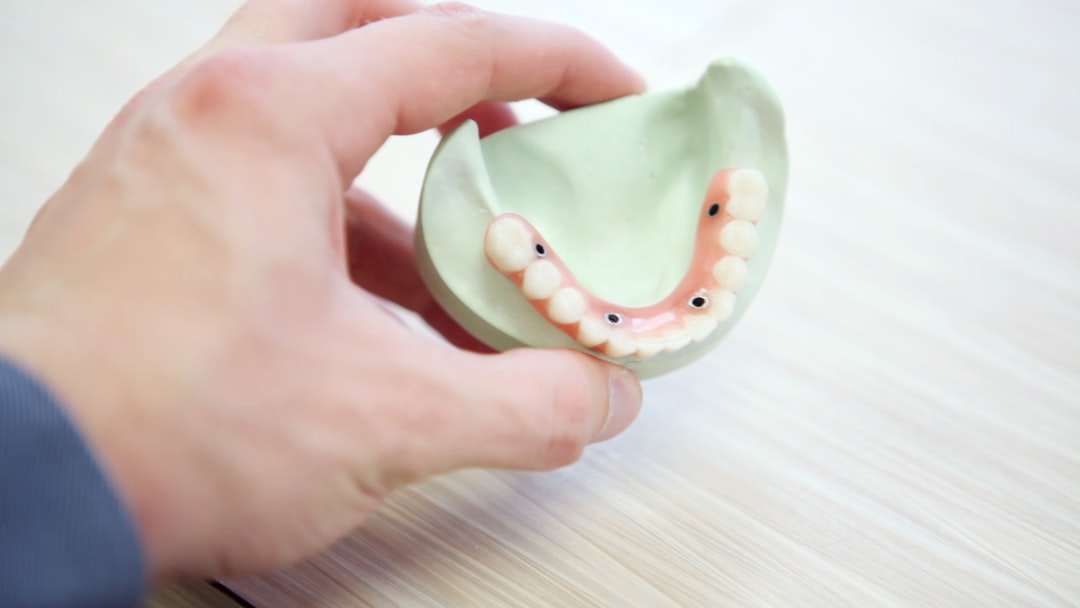
A bridge in mouth is a fixed dental restoration that replaces one or more missing teeth by literally bridging the gap between healthy teeth. Here's what you need to know:
Quick Answer:
- What it is: A permanent dental device that fills gaps left by missing teeth.
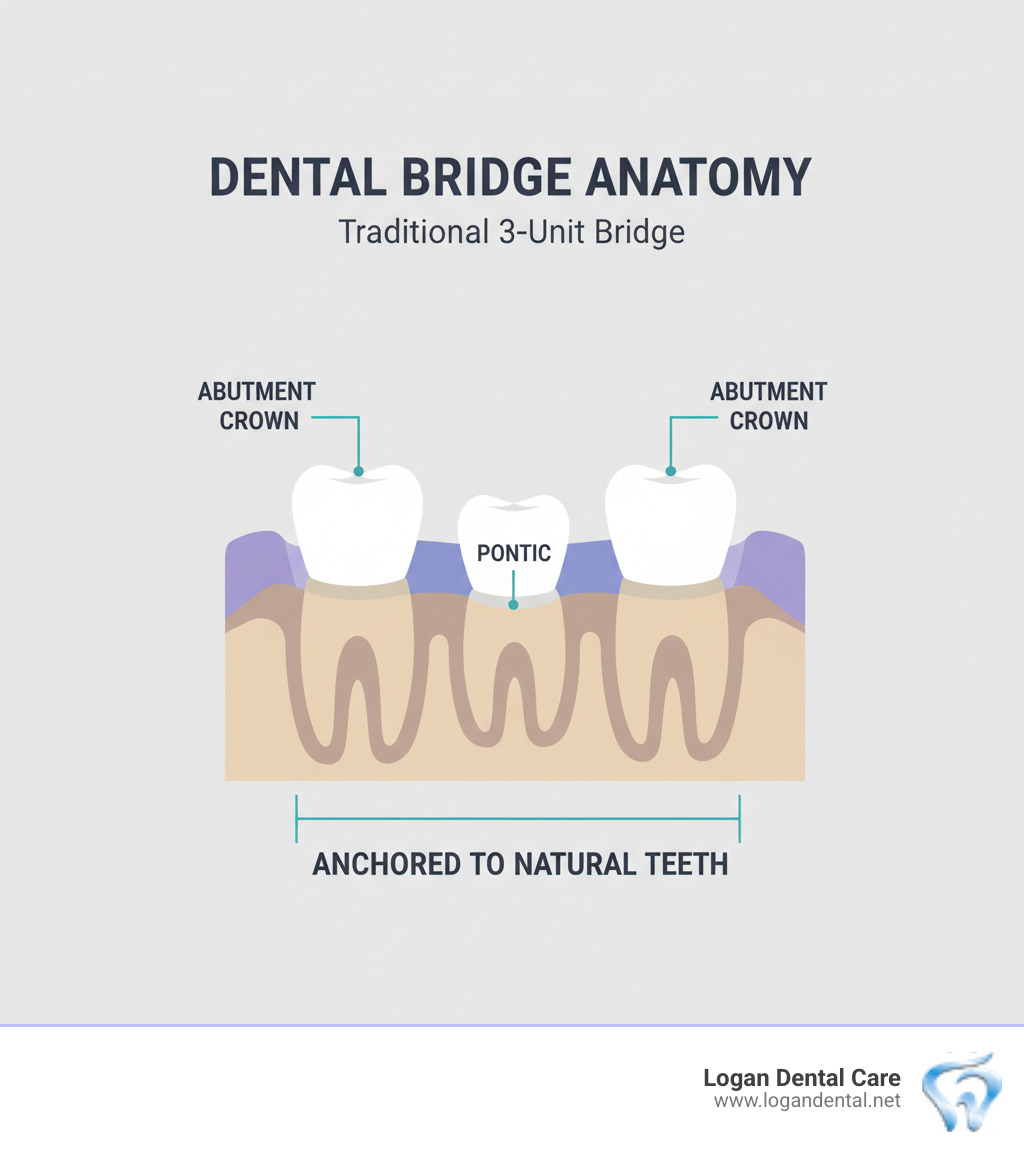
- How it works: Artificial teeth (pontics) are anchored to crowns placed on adjacent natural teeth or implants.
- Common types: Traditional, cantilever, Maryland, and implant-supported.
- Lifespan: Typically 5-15 years with proper care.
- Not removable: Unlike dentures, bridges are cemented in place.
Losing a tooth from an accident, decay, or extraction affects more than just your smile—it impacts how you chew and speak. The good news is that dental bridges offer a reliable solution. According to the American Dental Association, the average adult has three or more decayed or missing teeth, making tooth replacement a common and important procedure.
A dental bridge uses your healthy neighboring teeth as anchors (called abutments) to support one or more artificial teeth (pontics). The result is a natural-looking restoration that's permanently cemented, allowing you to eat, speak, and smile with confidence without the need for removal like dentures.
The procedure typically requires two dental visits. In the first, your dentist prepares the anchor teeth and takes impressions for your custom bridge. You'll leave with a temporary bridge. At the second visit, your permanent bridge is fitted and cemented into place, completing your smile.
A Closer Look at Getting a Bridge in Your Mouth
When considering a bridge in mouth, the right type depends on your missing tooth's location and the health of surrounding teeth. Let's review the four main types.

Traditional bridges are the most common type. They consist of an artificial tooth held in place by crowns cemented onto healthy teeth on both sides of the gap. This requires reshaping the adjacent teeth to ensure a secure fit, creating a very strong restoration.
Cantilever bridges are used when there is only one adjacent tooth to support the bridge. This design anchors to just one side, but it carries a higher risk of complications and is reserved for specific cases.
Maryland bridges offer a more conservative approach. Instead of crowns, a metal or porcelain framework is bonded to the back of adjacent teeth. This preserves more of your natural tooth structure but is not as strong as a traditional bridge, making it better for front teeth.
Implant-supported bridges are the premium option for replacing multiple teeth. They are anchored to dental implants surgically placed in the jawbone, not natural teeth. This provides superior stability and helps preserve jawbone density, though the process takes several months.
Want to explore these options in more depth? Check out our blog on Fixed Partial Denture Options for detailed information.
The Dental Bridge Procedure and Its Benefits
Getting a dental bridge is an investment in your quality of life. The benefits are significant:
- Restores your ability to chew properly
- Improves speech by eliminating gaps
- Prevents remaining teeth from shifting into the empty space
- Maintains your natural facial shape
- Boosts confidence with a complete smile
The process for a traditional bridge in mouth typically involves two visits. During the first visit, we prepare the abutment teeth by removing a small amount of enamel, then take precise impressions to create your custom bridge. A temporary bridge is placed to protect the area. On your second visit, we remove the temporary bridge, check the fit and appearance of your new permanent one, and then cement it securely in place.
While traditional bridges require irreversible alteration of healthy teeth and carry a small risk of decay under the crowns, these risks are minimal with proper oral hygiene and regular check-ups. For more perspective, you can read Why You Might Need a Dental Bridge.
Alternatives to a Bridge in the Mouth
A bridge in mouth is a great solution, but it's not the only one. The two main alternatives are dental implants and partial dentures.
Dental implants are considered the gold standard. A titanium post is surgically placed into the jawbone to act as an artificial root, and a crown is attached after it fuses with the bone. Implants feel natural, prevent bone loss, and don't require altering adjacent teeth. The process is longer and costs more upfront, but their longevity can make them cost-effective over time.
Partial dentures are a removable, more affordable option. They consist of replacement teeth on a gum-colored base that clasps onto your natural teeth. While they restore appearance and function, they may not feel as stable as fixed options and don't prevent bone loss.
Here's a quick comparison:
| Feature | Dental Bridge | Dental Implants | Partial Dentures |
|---|---|---|---|
| Cost | Moderate ($4,100-$9,650 average) | High upfront, potentially lower long-term | Most affordable upfront |
| Longevity | 5-15 years with proper care | 20+ years, often lifetime | 5-10 years |
| Procedure | 2 visits, abutment prep required | Surgical implant placement, healing period, then crown | Impressions and fitting, removable |
| Bone Health | Doesn't stimulate bone, potential loss underneath | Stimulates jawbone, prevents bone loss | Doesn't stimulate bone |
| Adjacent Teeth | Requires reshaping healthy teeth | Doesn't affect adjacent teeth | Clasps may stress adjacent teeth |
| Removability | Fixed, permanent | Fixed, permanent | Removable for cleaning |
| Feel & Function | Natural once adjusted | Most like natural teeth, strong bite | Can feel less stable, may shift |
To find the best fit for your health, lifestyle, and budget, we recommend a conversation with our team. For more insights, see our article on Dental Implants vs Bridges: Which Tooth Replacement Option is Best for You?.
How Long Will My Dental Bridge Last?
After your bridge is placed, there's a brief adjustment period of a week or two as your mouth gets used to it. Some temporary sensitivity to hot or cold is normal and should fade quickly.
On average, a dental bridge lasts five to seven years, but with excellent care, many last for ten to fifteen years or more. Several factors influence its lifespan:
- Oral Hygiene: Diligent cleaning is the most critical factor. Poor hygiene can lead to decay on supporting teeth, causing bridge failure.
- Materials: Modern materials like zirconia offer exceptional strength and longevity.
- Biting Forces: A bridge in the back of the mouth endures more pressure, which can affect its lifespan.
- Health of Abutment Teeth: The foundation must remain strong and free of decay or gum disease.
- Regular Dental Visits: Professional cleanings and check-ups at Logan Dental Care allow us to catch small issues early.
Your bridge's longevity is a partnership. We provide a high-quality restoration, and your daily care ensures it lasts for years to come.
Life with Your Dental Bridge: Care, Costs, and Longevity
Life with a new bridge in mouth means renewed confidence, better chewing, and clearer speech. To ensure your bridge lasts, it needs consistent care, and our team at Logan Dental Care is here to support you.

Caring for Your Bridge in the Mouth
The key to a long-lasting bridge is a solid oral hygiene routine with a few extra steps.
- Brushing: Brush at least twice a day with a non-abrasive fluoride toothpaste, paying close attention to the area where the bridge meets your gums and natural teeth.
- Cleaning Under the Bridge: It's crucial to clean under the pontic (the artificial tooth) to remove plaque and food particles. You can use specialized tools for this:
- Floss threaders help guide regular floss under the bridge.
- Interproximal brushes are small brushes designed to clean tight spaces.
- Water flossers use a stream of water to flush out debris.
- Diet: Avoid extremely hard, sticky, or chewy foods (like hard candy, caramel, or ice) that could damage or dislodge your bridge.
- Regular Check-ups: Visit us at Logan Dental Care at least twice a year for professional cleanings and examinations. We can clean hard-to-reach areas and check the integrity of your bridge and abutment teeth.
If your bridge feels loose, you experience pain, or your gums become sensitive, call us right away. Early intervention is key to preventing bigger problems.
Understanding the Cost of a Dental Bridge
Understanding the investment is an important part of your decision. At Logan Dental Care in Logan County, OH, we believe in being transparent about costs.
The national average cost for a traditional dental bridge is around $5,197, with a typical range of $4,100 to $9,650. Several factors influence the final price:
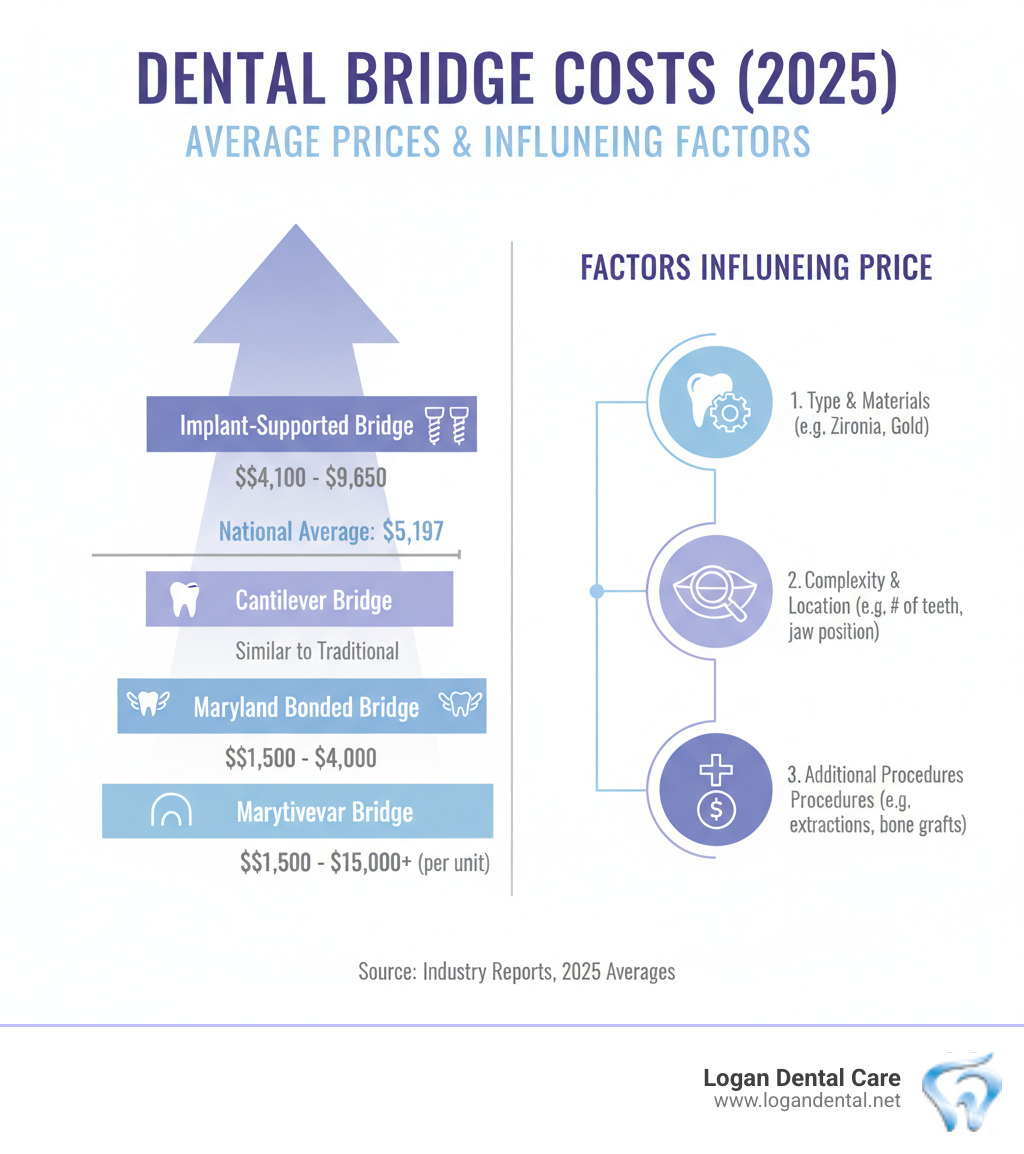
- Type of Bridge: Traditional and cantilever bridges fall within the average range. Maryland bridges are often less expensive, while implant-supported bridges cost more due to the surgical implant placement.
- Materials: All-ceramic materials like zirconia offer superior aesthetics and durability but may cost more than porcelain-fused-to-metal options.
- Number of Teeth: The cost increases with each tooth being replaced.
- Additional Procedures: The total expense will be higher if you need preliminary work like gum disease treatment, fillings, or bone grafts.
- Location: Dental costs can vary by region.
Many dental insurance plans cover a portion of the cost of a bridge. Our team is happy to help you understand your benefits and estimate any out-of-pocket expenses.
We believe everyone deserves quality dental care. If you're ready to take the next step, we invite you to Schedule a consultation for Crowns and Bridges with our friendly team. We'll provide a personalized assessment and a clear cost breakdown to help you make a confident decision.