
How a 5 Tooth Bridge Can Save Your Smile
What a 5 Tooth Bridge Is — and Whether It's Right for You
A 5 tooth bridge is a fixed dental restoration that replaces five consecutive missing teeth using artificial teeth (called pontics) anchored to natural teeth or implants on either side of the gap.
Quick answer for people exploring this option:
- What it is: A fixed prosthesis with 2 anchor crowns and 3-5 artificial teeth.
- Who it is for: Adults missing 4-5 adjacent teeth with healthy supporting teeth or implants.
- How long it lasts: Usually 10-15 years, and sometimes 20+ with excellent care.
- Is it removable? No. Only a dentist can remove it.
- Main types: Traditional tooth-supported bridges and implant-supported bridges.
Missing several adjacent teeth does a lot more damage than most people realize. It's not just about how your smile looks. It changes how you chew, how clearly you speak, and how your facial muscles and jaw are supported over time.
In fact, roughly 178 million Americans are missing at least one tooth — and losing multiple teeth in the same area compounds the problem fast. Neighboring teeth begin to shift. Bone starts to deteriorate. Chewing becomes uneven, which puts stress on the rest of your bite.
A 5-unit bridge is one of the most effective long-span solutions dentistry offers. But it's also one of the more complex restorations — and not every patient or situation is the same.
This guide walks you through everything you need to know: how a 5 tooth bridge works, what types are available, what the procedure looks like, and how to keep it in great shape for decades.
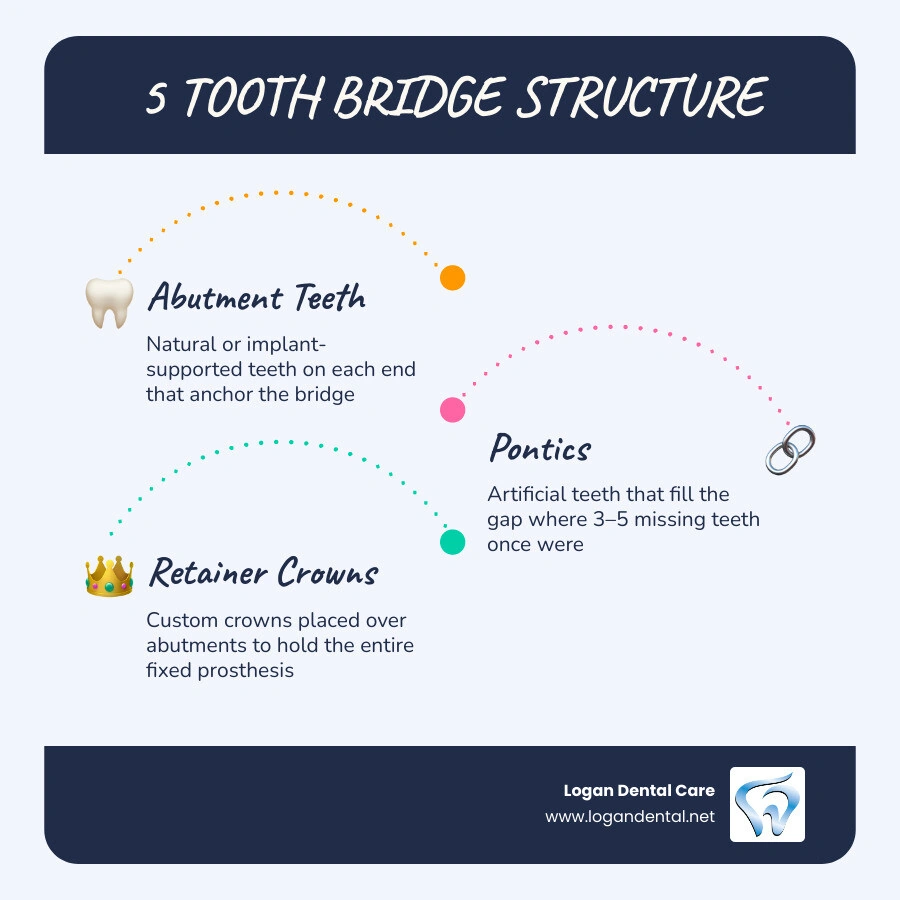
5 tooth bridge terms to know:
Understanding the 5 Tooth Bridge and How It Works
A 5 tooth bridge works by spanning an empty space where several teeth are missing in a row. The teeth or implants that support the bridge are called abutments. The replacement teeth in the middle are called pontics.
Think of it like a literal bridge: the supports at each end carry the load in the middle. That matters because the back teeth can generate significant chewing force, and long-span bridges have to handle repeated pressure every day. That is why case selection, design, and material choice are so important.
A well-made bridge can help:
- Restore chewing efficiency
- Improve speech clarity
- Maintain bite alignment
- Prevent nearby teeth from drifting
- Support the shape of the cheeks and lips
If you are new to the idea, our article on a bridge in mouth gives a helpful foundation.
Components of a 5-Unit Bridge
A 5-unit bridge usually includes:
- Retainer crowns on the support teeth, if it is tooth-supported
- Pontics, which are the artificial replacement teeth
- A connected framework that keeps the whole restoration stable
- A fixed design, meaning it stays in place and is removed only by a dentist
In some cases, a bridge replacing five teeth may involve more than five total units because the support crowns count as units too. The exact design depends on how many teeth are missing, where the gap is located, and whether support comes from natural teeth or implants.
For a broader overview of treatment options, see our page on crowns and bridges.
Candidacy for a 5 Tooth Bridge
A long-span bridge is not ideal for everyone. We usually look at several factors before recommending one:
- Healthy gums with no uncontrolled periodontal disease
- Strong support teeth, if using a traditional bridge
- Adequate bone if implants are being considered
- Good daily oral hygiene habits
- A stable bite
- Overall health factors that may affect healing
Age matters too. Most long-span fixed bridges are considered for adults after jaw growth is complete. In younger patients, temporary or conservative options may be more appropriate.
At Logan Dental Care, we always want the foundation to be healthy before placing a major restoration. Sometimes that means treating gum disease first or addressing decay before bridge work begins. A beautiful bridge on an unhealthy foundation is a little like building a porch on wet soil - it may look fine at first, but it will not perform the way it should.
Types of Long-Span Dental Bridges
There are four classic bridge categories, but not all are equally suitable for replacing four or five missing teeth.
- Traditional fixed bridge
- Implant-supported bridge
- Cantilever bridge
- Maryland bridge
For a helpful companion read, visit fixed partial denture options.
Here is the practical comparison:
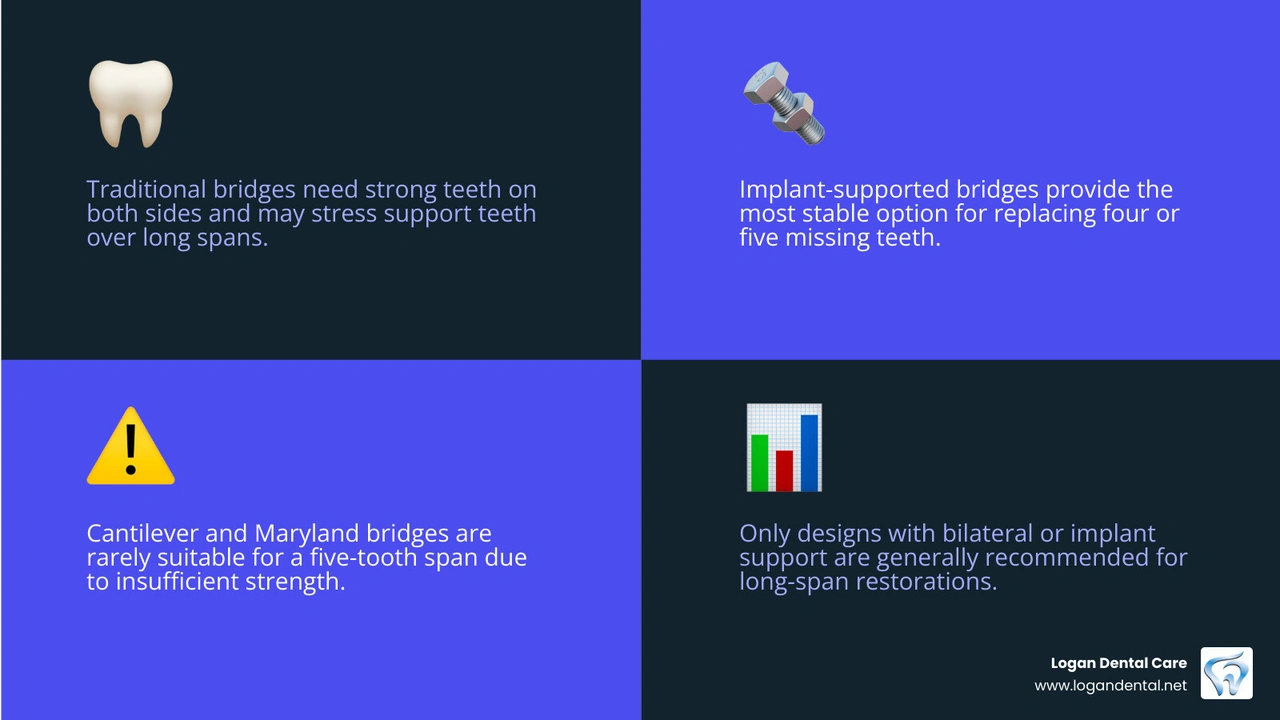
Traditional bridge: Supported by natural teeth on both sides. It can work for longer spans only when the support teeth are very strong.
Implant-supported bridge: Anchored to dental implants. This is usually the most stable choice for a 5-tooth gap.
Cantilever bridge: Supported on one side only. It is rarely recommended for a 5-tooth span.
Maryland bridge: Held by bonded wings behind nearby teeth. It is usually better for smaller front-tooth gaps.
Traditional bridges remain common, but a five-tooth span places more stress on the support teeth. Cantilever and Maryland designs are generally limited in this situation because they do not offer enough strength for long-term function in most cases.
The Advantages of an Implant-Supported 5 Tooth Bridge
For many patients missing several teeth in a row, an implant-supported bridge offers major advantages:
- It does not rely entirely on natural teeth for support
- It helps preserve bone in the jaw
- It often provides better stability for chewing
- It can reduce overload on neighboring teeth
- It may offer stronger long-term performance
Implants act like artificial roots. After placement, they heal through osseointegration, which means the titanium post fuses with the surrounding bone. Once healed, those implants can support a bridge above them.
This approach can be especially valuable for long spans. You can learn more in our bridgework teeth complete guide.
Materials, Procedure, and Longevity
Modern bridges can be made from several materials, each with trade-offs in strength, appearance, and cost.
Common options include:
- Zirconia: very strong and popular for high-bite-force areas
- Porcelain-fused-to-metal (PFM): a long-used option that balances strength and esthetics
- Lithium disilicate or e.max: attractive and lifelike, often best in visible areas, though not always the first choice for very long spans
- Other ceramics and CAD/CAM-milled blends depending on the case
Material choice depends on:
- Where the bridge sits in the mouth
- How hard you bite
- Whether you grind your teeth
- Esthetic priorities
- The design of the bridge itself
You can also explore our article on bridge for teeth for more background.
Step-by-Step 5 Tooth Bridge Procedure
The exact process depends on whether the bridge is tooth-supported or implant-supported, but the general sequence looks like this:
Consultation and exam
We evaluate the missing-teeth area, gums, bite, bone levels, and supporting teeth. X-rays or digital scans help us plan safely and precisely.Treatment planning
We decide whether a traditional or implant-supported bridge makes the most sense.Tooth preparation or implant phase
For a traditional bridge, the support teeth are reshaped so crowns can fit over them.
For an implant-supported bridge, implants are placed first and allowed to heal before the final bridge is made.Impressions or digital scans
We capture the exact shape of your teeth and bite.Temporary restoration
A temporary bridge may be placed while the final one is being fabricated.Final fitting
The final bridge is checked for fit, bite balance, comfort, and appearance.Bonding or cementation
Once everything looks and feels right, the bridge is secured in place.
Most patients adjust within days to a couple of weeks, though implant cases take longer overall because healing time is part of the process.
Longevity and Warning Signs
A dental bridge typically lasts about 5 to 15 years, and many last longer with excellent care. Some well-maintained bridges can function for 20 years or more.
What affects longevity?
- Quality of the support teeth or implants
- Material used
- Bite forces and clenching
- Home care habits
- Gum health
- Regular professional checkups
Warning signs that a bridge needs attention include:
- Bad smell or persistent bad taste
- Sensitivity around support teeth
- Gum bleeding around the bridge
- Looseness or movement
- Pain when chewing
- Chipping, cracking, or wear
- Food trapping that suddenly gets worse
These are not symptoms to "just watch for six months." A small issue under a bridge can become a big one quietly.
Cost, Insurance, and Maintenance
The cost of a 5 tooth bridge can vary widely depending on:
- Whether it is traditional or implant-supported
- Material selection
- Number of support units
- Complexity of the case
- Need for additional treatment such as gum therapy, root canal treatment, or implant preparation
- Lab and imaging costs
Dental insurance may help if the bridge is considered medically necessary restorative care rather than cosmetic treatment. Many plans treat bridges as a major service, but actual coverage depends on the plan, waiting periods, deductibles, and yearly maximums.
Our advice is simple: ask for a written, itemized estimate and verify benefits before treatment begins.

Daily maintenance matters just as much as the bridge itself. The basics include:
- Brush twice daily with fluoride toothpaste
- Clean under the bridge every day with floss threaders or superfloss
- Consider a water flosser for debris removal
- Keep regular checkups and cleanings
- Avoid chewing ice, pens, and very hard foods
- Wear a nightguard if you clench or grind
Managing Halitosis and Bridge Hygiene
Halitosis simply means chronic bad breath, and bridges can contribute if plaque and food collect underneath the pontics.
The usual culprits are:
- Bacteria trapped under the bridge
- Inflammation of the gums around abutment teeth
- Poor cleaning technique
- A bridge that no longer fits well
- Dry mouth
- Tongue coating or other oral sources unrelated to the bridge
The good news: bridge-related odor is often preventable.
A solid daily routine includes:
- Brushing along the gumline
- Cleaning under each pontic nightly
- Using superfloss, threaders, or an interdental brush as recommended
- Rinsing with an alcohol-free antibacterial mouthwash if appropriate
- Cleaning the tongue as well
If bad breath continues despite good home care, it is worth having the bridge examined. Sometimes the issue is not "bad breath" at all but early decay, gum infection, or a gap where bacteria are hiding.
Frequently Asked Questions about 5 Tooth Bridges
How much does a 5 tooth bridge cost in 2026?
There is no one-size-fits-all price. In 2026, the total cost depends mostly on bridge type, material, complexity, and whether implants are involved. Implant-supported designs usually cost more upfront than tooth-supported bridges because they involve surgery, healing, and additional components.
Insurance may cover part of the treatment, but many plans cap benefits with annual maximums. That is why a written estimate is so helpful.
Can a bridge really replace five teeth in a row?
Yes, sometimes. But it requires enough support. Most bridges replace one to three teeth, and replacing four or five is a more demanding situation biomechanically. That is why long-span bridges need careful planning and why implant support is often considered for larger gaps.
In short: possible, yes. Appropriate in every case, no.
Is a 5 tooth bridge better than a partial denture?
It depends on the person.
A fixed bridge may offer:
- Better chewing confidence
- A more natural feel
- No daily removal
- Stronger esthetic results for many patients
A partial denture may offer:
- Lower upfront cost
- Easier replacement if more teeth are lost later
- A non-surgical option when support is limited
Compared with implants, bridges are often faster and less invasive. Compared with partial dentures, bridges usually feel more secure. The best choice depends on support, health, budget, and goals.
Conclusion
A 5 tooth bridge can do much more than fill a gap. It can restore chewing, support speech, protect your bite, and help you feel like yourself again. For the right patient, it is an excellent long-span solution.
At Logan Dental Care, we believe major dental decisions should feel clear, comfortable, and personal. If you are in Bellefontaine or anywhere in Logan County and want to talk through your options, we are here to help you sort through the pros, cons, and what truly fits your smile.
Ready to take the next step? Schedule your consultation for crowns and bridges.