
A Patient Guide to Comfort and Sedation for Implant Care
Understanding Sedation for Implant Surgery: Methods and Levels of Comfort
Over 40% of adults experience some degree of dental anxiety, often putting off necessary treatments because of worry or past negative experiences. When planning restorative treatment, understanding how clinical teams approach procedural comfort can ease concerns and help set clear expectations.
Sedation dentistry uses medications to help patients feel calm and at ease during care. It differs fundamentally from local numbing: while local anesthetics block nerve signals so you do not feel pain, sedatives work on the central nervous system to reduce anxiety, slow racing thoughts, and minimize physical tension. Depending on the depth of sedation, patients remain awake and responsive or enter a light, dream-like state. You can read more about surgical anesthesia guidelines from FOR.org to learn how clinical teams tailor these comfort measures.
Nitrous Oxide and Oral Conscious Sedation for Implant Procedures
For mild to moderate nervousness, two popular conscious options include inhalation analgesia and oral sedatives:
- Nitrous Oxide (Laughing Gas): Blended with pure oxygen and inhaled through a soft nose mask, nitrous oxide produces a light, pleasant, floating sensation within minutes. It helps take the edge off procedural sounds and smells. A significant advantage is how rapidly it clears the body; within five minutes of switching back to pure oxygen, the effects dissipate entirely.
- Oral Conscious Sedation: Usually prescribed as a pill (such as a benzodiazepine) taken about an hour before surgery. It provides deeper relaxation than nitrous oxide. Patients remain awake and able to respond to simple directions, but they feel distinctly drowsy and calm. It is frequently discussed when evaluating different dental implant options that require slightly longer appointments. Because oral sedatives linger in the system for several hours, patients require a companion to drive them to and from the appointment.
Intravenous (IV) Sedation for Implant Placement and Complex Cases
Intravenous (IV) conscious sedation delivers sedative medications directly into the bloodstream through a small catheter. This allows an anesthesia provider or certified oral surgeon to adjust medication levels immediately to match the patient's comfort and the surgical pace.
During IV sedation, clinical teams often administer an initial dose of midazolam to establish calm, followed by a controlled infusion of propofol to maintain a steady level of relaxation throughout the procedure (Craig et al., 2000). Patients enter a "twilight sleep" where they breathe independently and maintain protective reflexes, yet experience profound relaxation and temporary amnesia, remembering little to nothing about the drilling sounds or sensations during the step-by-step tooth implant process. In fact, a three-year cohort study on IV sedation and implant outcomes found that IV sedation yielded exceptionally high patient satisfaction alongside 100% three-year implant survival rates.
Local Anesthesia and Advanced Numbing Techniques
Regardless of whether sedation is used, effective local anesthesia remains the cornerstone of pain-free surgical placement. Modern dentistry relies on advanced anesthetic solutions and precise delivery methods:
- Infiltration Anesthesia: Direct numbing around the surgical site, highly effective in the upper jaw (maxilla) where bone is naturally porous.
- Nerve Blocks: Delivering anesthetic near primary nerve branches, such as the inferior alveolar nerve in the lower jaw (mandible), to numb an entire quadrant thoroughly.
- Targeted Agents: Formulations such as 4% articaine provide deep penetration through dense bone, while long-acting agents like bupivacaine or ropivacaine can provide extended periosteal numbing that keeps you comfortable for hours after leaving the chair.
Key Factors in Selecting the Right Sedation Approach
Choosing whether to incorporate sedation for implant placement involves a comprehensive health and lifestyle evaluation to ensure safety and comfort.
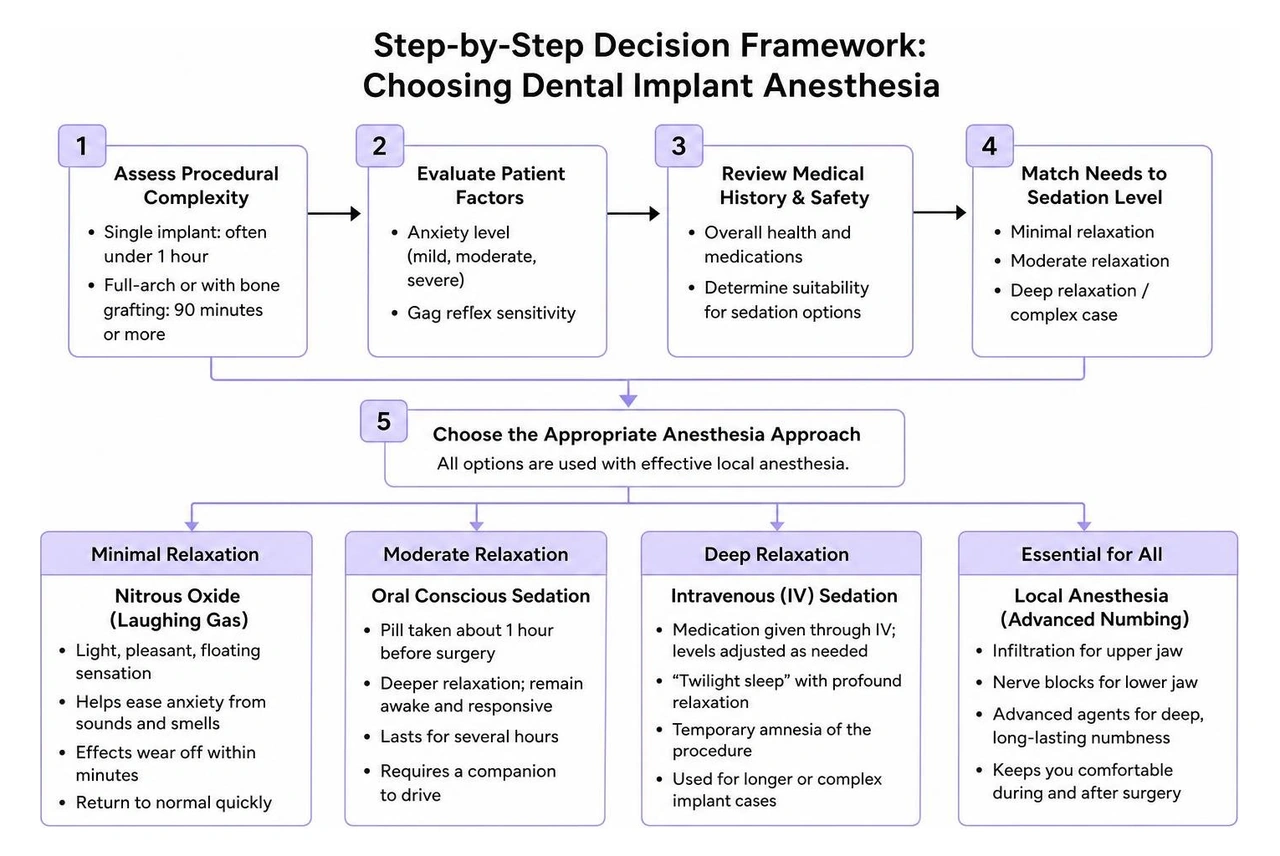
When reviewing the safety of dental implants, providers evaluate several essential factors:
- Procedural Complexity: Placing a single implant often takes under an hour, whereas full-arch restorations or combined bone grafting procedures can take 90 minutes or more.
- Patient Anxiety Levels: Moderate-to-severe anxiety can trigger stress responses that interfere with smooth treatment if not managed.
- Gag Reflex Sensitivity: An active gag reflex can make surgical instruments uncomfortable without mild sedation.
- Underlying Medical Conditions: Cardiovascular, respiratory, hepatic, and metabolic health dictate which medications are safe.
Patient Anxiety and Medical History Considerations
Preoperative anxiety significantly impacts patient perception. In clinical observations, unmanaged moderate-to-severe anxiety reduced patient satisfaction in 72.2% of surgical cases (Ito et al., 2023). Sedation helps break this cycle of stress.
Medical evaluations classify patients using the American Society of Anesthesiologists (ASA) Physical Status system. Healthy individuals (ASA I) or those with well-controlled mild systemic disease (ASA II) are standard candidates for conscious sedation. For older adults, age-related changes in drug metabolism mean providers carefully titrate medications at lower starting doses to ensure smooth recovery without prolonged grogginess.
Special Precautions for Cardiovascular Health and Vasoconstrictors
For patients managing high blood pressure or heart conditions, anxiety itself causes the body to release natural adrenaline, elevating heart rate and blood pressure. Sedation helps maintain calm, stabilizing these vital signs.
Simultaneously, local anesthetics often contain vasoconstrictors (like epinephrine) to prolong numbing and minimize bleeding. A clinical review on satisfactory sedation during implant surgery highlights that using diluted epinephrine solutions (such as 1:200,000) or choosing alternative agents like ropivacaine provides excellent operative anesthesia without placing unnecessary stress on the cardiovascular system (Ito et al., 2023).
Clinical Benefits and Long-Term Implant Success
Ensuring complete comfort during surgery offers tangible physiological and clinical advantages beyond simply feeling relaxed. When patients are calm, surgeons can work with steady precision, especially when restoring multiple missing teeth.
Osseointegration, Healing, and Maintenance Attendance
Minimizing surgical stress suppresses excess cortisol and inflammatory surges, supporting initial soft tissue healing. Most patients recover from initial surgical soreness in 7 to 10 days, while full osseointegration—where the titanium post fuses permanently with the jawbone—progresses smoothly over the following months.
Interestingly, research indicates that positive procedural experiences directly influence long-term oral health habits. In a retrospective study tracking implant outcomes, patients who received IV sedation demonstrated a 96.8% attendance rate for their six-month professional maintenance visits, compared to 63.0% among those treated with local anesthesia alone. Consistent follow-up care is one of the most critical factors in preventing peri-implant complications and ensuring lifelong implant stability.
Advanced Monitoring and Newer Sedative Agents

Patient safety during moderate to deep sedation relies on continuous physiological monitoring, including:
- Continuous pulse oximetry (blood oxygen saturation)
- Automated non-invasive blood pressure tracking
- Electrocardiogram (ECG) rhythm monitoring
- Capnography (end-tidal CO2 monitoring of breathing rate)
- Bispectral Index (BIS) monitoring to objectively measure sedation depth
Pharmacological advancements have introduced newer sedative agents such as dexmedetomidine, which provides sedation with minimal respiratory depression (Ito et al., 2023), and remimazolam, an ultra-short-acting benzodiazepine that allows rapid recovery and can be quickly reversed with flumazenil if needed (Ito et al., 2023).
Recovery Expectations and Post-Procedure Care
A smooth recovery starts with understanding what to expect after your appointment ends.
What to Expect Immediately After Surgery
If you received nitrous oxide, you will feel completely back to normal before leaving the office and can drive yourself home.
If you had oral or IV sedation, expect to feel groggy and relaxed for several hours. You will need a trusted friend or family member to drive you home, assist you with getting settled, and keep an eye on you for the remainder of the day. Local numbing in the gums and jaw will persist for a few hours, protecting you from immediate post-operative soreness.
Evidence-Based Home Healing Guidelines
To protect the surgical site and promote rapid tissue healing, follow these foundational home care practices:
- Rest Quietly: Spend the first 24 hours relaxing with your head slightly elevated on pillows to reduce localized throbbing and swelling.
- Manage Swelling: Apply an ice pack wrapped in a clean cloth to the cheek near the surgical site in 15-minute intervals during the first 24 to 48 hours.
- Stick to Soft Foods: Eat cool or lukewarm soft foods (like smoothies, yogurt, scrambled eggs, and warm broths) for the first few days. Avoid drinking through straws, which can create suction and disturb blood clots.
- Gentle Hygiene: Avoid vigorous rinsing or brushing directly over the surgical site for the first 24 hours. After the first day, gentle warm salt-water rinses (half a teaspoon of salt in a glass of warm water) after meals keep the area clean and soothe healing gums.
- Take Prescribed Medications: Take any prescribed analgesics or over-the-counter pain relievers exactly as recommended by your surgical team before the local numbness completely wears off.
Frequently Asked Questions About Implant Comfort
Will I feel any pain during dental implant surgery?
No. With modern local anesthesia, the nerve pathways in the gums and bone are completely blocked. You will feel light pressure and movement as the surgical team works, but you should not feel sharpness or pain. Sedation further eliminates procedural anxiety so that physical sensations feel distant and unbothered.
How long does it take for sedation to wear off after the procedure?
Nitrous oxide clears from your lungs and bloodstream within 5 minutes of breathing oxygen. Oral sedatives and IV medications take longer to metabolize; while you will be conscious and responsive when discharged, mild drowsiness, slowed reflexes, and reduced coordination can linger for 6 to 12 hours.
Can I drive myself home after receiving sedation?
You may drive yourself home only if your procedure involved nitrous oxide alone or standard local anesthesia. If you receive oral conscious sedation or IV sedation, you must have an adult companion accompany you to the office, drive you home safely, and remain available while you rest.
Conclusion
Restoring your smile with dental implants is an exciting step toward better chewing function, oral health, and everyday confidence. Knowing the various comfort and anesthesia options available empowers you to have productive, reassuring conversations with your treating provider.
At Logan Dental Care, we are committed to providing top-quality general, family, cosmetic, orthodontic, and restorative dentistry—including beautiful crowns, bridges, and restorative dental implant solutions—in a welcoming, family-focused environment. While Logan Dental Care does not offer sedation dentistry, our team at 1021 N. Main Street in Bellefontaine is always here to guide our Logan County neighbors with transparent, caring advice for every stage of your dental journey.